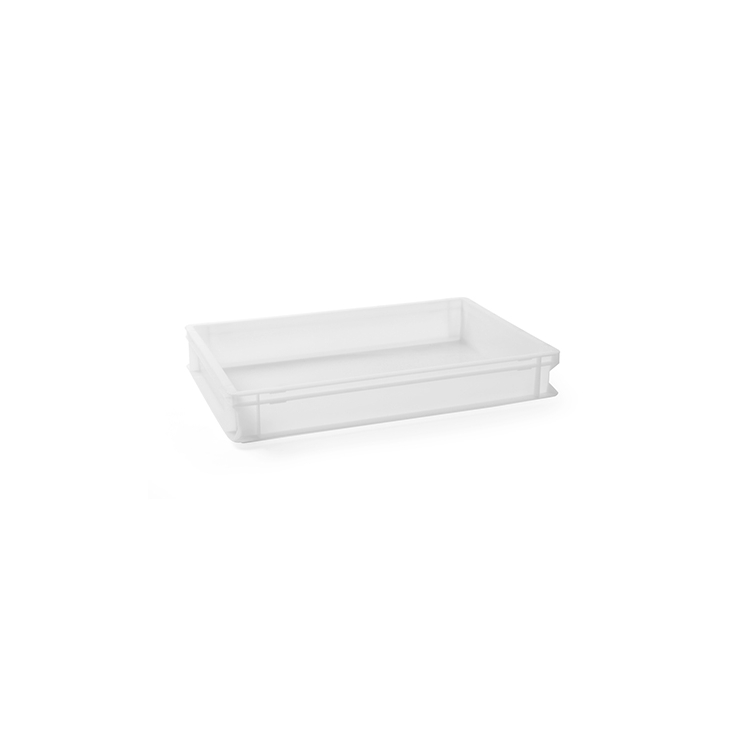
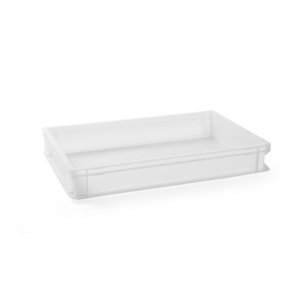
In any pizzeria that makes its own dough, the dough ball box is the tool at the heart of the lab's organisation. It holds the individual dough balls after balling, during fermentation — whether short at room temperature or long in the fridge. A well-conditioned dough ball in a suitable box means a pizza that opens easily, with an airy crust and a developed flavour. A badly stored dough ball (box too small, sticky plastic, air drying the surface) means a dough that tears when stretched and a service that derails.
Why this box is the standard in all professional pizzerias
The 600×400 mm format was not chosen at random: it is exactly the GN 1/1 (gastronorm) format, the universal standard of professional catering equipment. Concretely, this box fits into all your cold cabinets, proofing cabinets and professional shelving without adaptation. With a depth of 70 mm, you comfortably hold dough balls of 200 to 350 g with enough room for them to rise without touching each other and without reaching the lid — essential to avoid dry crusts on the surface and stuck dough balls.
Stackability is an underrated daily asset: during a long fermentation, you prepare 24 to 72 h in advance and store several boxes. Without stackable boxes, each tray takes a whole shelf. With these boxes, a cold cabinet of 7 GN 1/1 holds 7 boxes in a column, i.e. 42 to 70 dough balls in a single unit.
Fermentation — getting the best from your dough balls
Fermentation is the step that distinguishes a memorable pizza from an ordinary one. In this box, individual dough balls have enough room to rise without touching, while staying protected from air (with lid or film) and from drying out. Two reference protocols:
- Short direct fermentation (4-8 h at 20-24°C): suited to day-to-day production. The box stays at room temperature or in a proofing cabinet at 24°C. The dough balls double in surface volume, the dough is supple and easy to stretch.
- Long indirect fermentation (24-72 h at 4-6°C): Neapolitan and contemporary method. The balled dough is placed in the boxes in the fridge from the day after kneading. The slow fermentation develops complex aromas, improves digestibility and strengthens the gluten structure.
Technical specifications
| External dimensions | 600 × 400 × 70 mm |
|---|
| Format | Gastronorm GN 1/1 |
|---|
| Material | Food-grade HDPE (high-density polyethylene) |
|---|
| Temperature range | −20°C to +70°C |
|---|
| Stackable | Yes |
|---|
| Dishwasher-safe | Yes (low rack) |
|---|
What pizzaiolos ask
- How many dough balls fit in a 600×400×70 mm box?
- As a rule, 6 to 10 dough balls of 200-280 g depending on layout. In rows of 2, you place 3 rows of 2 (6 well-spaced balls); staggered, you go up to 8-10 closer but still spaced enough to rise without sticking. For balls of 300 g or more, count on 6 per box to guarantee proofing space.
- Can this box go directly in the freezer?
- Yes, food-grade HDPE withstands down to −20°C. Freezing dough balls in this box is practised by production units working just-in-time. Note: freeze after balling (before fermentation) to preserve optimal quality. Defrost 12 h ahead in the fridge.
- Should I oil the box before placing the dough balls?
- Yes, a thin layer of olive oil or rapeseed oil on the bottom and walls prevents the dough balls from sticking when removed — especially for fermentation of 48 h or more. Some pizzaiolos spray the box directly with a food spray to go faster in production.
Delivery — Pizza dough ball box, GN 1/1, 600 × 400 × 70 mm. Delivery on request — write via the contact form for lead times.
MFF Guarantee & After-Sales: 1-year manufacturer guarantee, extended guarantee available. MFF technical support. Delivery 48–72h mainland France.