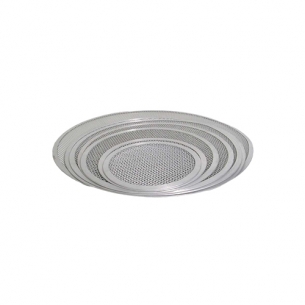
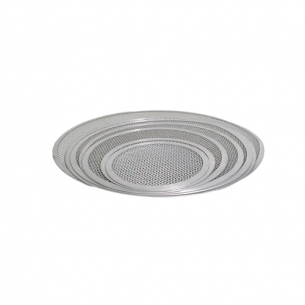
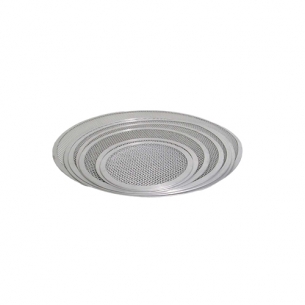
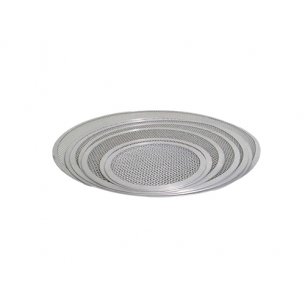
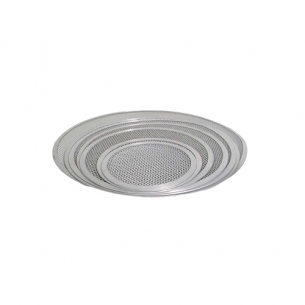
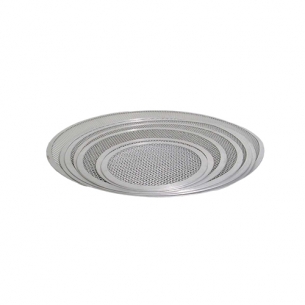
The Ø330 mm aluminium pizza screen is the intermediate format between the standard individual pizza (30 cm, Ø300) and the mid-large pizza (36 cm, Ø360). It matches the "large" or "maxi individual" pizza format offered in many pizzerias: 33 cm, a generous portion that stands out from the standard 30 cm without going to a sharing format. It is the reference format for pizzerias that standardise on 33 cm.
The 33 cm format (Ø330 mm) has grown popular in French pizzerias over the last decade, driven by the "more generous for the same price" trend and by contemporary Neapolitan pizza whose puffed rim (cornicione) sits better on a slightly larger diameter. The Ø330 screen is sized so the pizza rim rests exactly on the screen edge — the pizza is fully supported without overhanging, avoiding the rim sagging between the screen bars during baking.
Why a screen rather than a solid tray
The perforated aluminium screen produces a different bake from a solid tray or refractory stone. Placed directly on the screen, the pizza receives heat by convection (hot air circulating under the pizza) in addition to the heat radiated by the oven elements or burners. This double heat source speeds up the baking of the pizza base and produces a crisper crust than baking on a solid tray — the steam released by the dough escapes downward through the perforations instead of staying trapped under the pizza.
Food-grade aluminium is the reference material for professional pizza screens: light (makes fast handling in service easy), heat-resistant (withstands 250-300°C continuously without warping), easy to clean (smooth surface that does not hold burnt flour). The screens are compatible with professional dishwashers (60-70°C, fast cycles) — one pass per service is enough for routine maintenance.
Rotation and renewal
An aluminium pizza screen in intensive professional use (150-200 pizzas per day, 5 services per week) lasts on average 6 to 12 months before needing replacement — progressive warping under thermal cycling, build-up of ingrained baking residue, loss of flatness. Keeping 3-5 screens per format and per oven in rotation guarantees a clean, good-condition screen always available for service.
Specifications
| Diameter | Ø 330 mm |
|---|
| Material | Food-grade aluminium |
|---|
| Use | Large 33 cm individual pizza |
|---|
Aluminium screen range comparison
| Format | Diameter | Use |
|---|
| Screen Ø280 | 280 mm | Small individual pizza |
| Screen Ø300 | 300 mm | Standard individual pizza |
| Screen Ø330 | 330 mm | Large individual pizza |
| Screen Ø360 | 360 mm | Sharing / generous pizza |
| Screen Ø400 | 400 mm | Large pizza |
| Screen Ø450 | 450 mm | Family / maxi format |
What restaurant owners ask
- Is there a baking quality difference between the Ø300 and Ø330 screens?
- No — both use the same food-grade aluminium with the same perforated mesh. Baking quality (crispness, evenness) is identical. The only difference is the diameter. If your standard pizza format is 30 cm, use the Ø300 so the pizza sits well on the screen. If your format is 33 cm, the Ø330 is the right size. Using a 33 cm pizza on a Ø300 screen creates an overhang that can make the pizza slide off the edges during baking.
- Can the Ø330 screen be used for a 30 cm pizza?
- Technically yes — a 30 cm pizza fits on a Ø330 screen with 15 mm of play each side. The bake will be fine since the pizza is fully on the screen. The only downside is aesthetic: the screen is visible around the pizza by 15 mm, not ideal for presentation. In mixed rotation (30 and 33 cm), having the right-sized screen for each format remains best practice.
Delivery — Food-grade aluminium pizza screen. Consumable accessory, order in batches of 10-20 for service rotation. Delivery on request — write via the contact form for lead times and batch pricing.