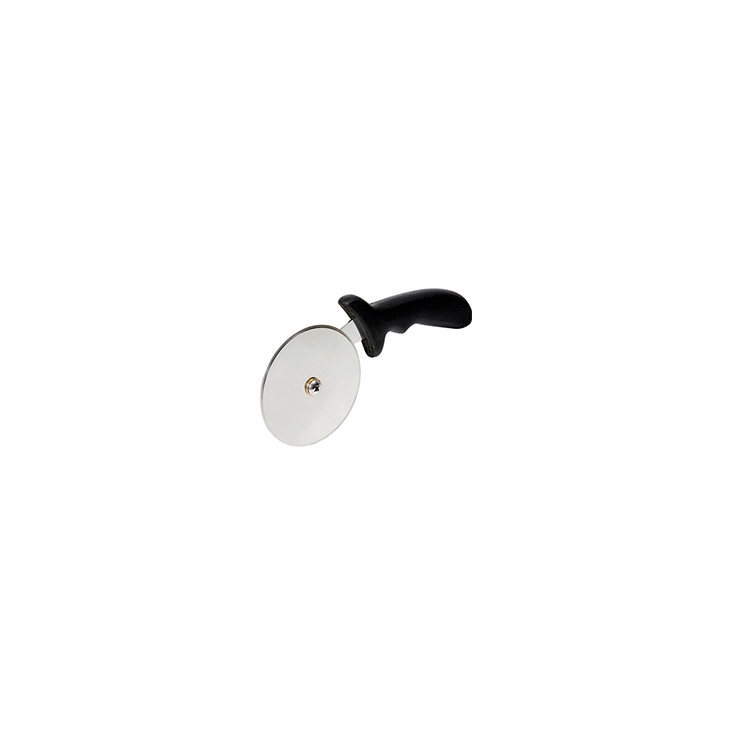
The professional pizza cutter wheel is the essential cutting tool of the pizzeria. A low-cost accessory whose quality directly impacts the speed and result of the cut: a good pizza cutter cuts in one clean, neat pass without crushing the dough or moving the toppings; a poor-quality or badly maintained cutter pulls the mozzarella and tears the pizza edges — a degraded presentation that is immediately noticed in service.
Why the wheel is the reference tool in a pizzeria
The wheel cutter is the standard pizza knife of professional pizzerias. Compared with pizza scissors or the mezzaluna half-moon cutter, the wheel offers a fast, fluid cut in one continuous movement — you place it on the pizza edge, press and roll to the other side, turn the pizza and repeat for the next slices. A service of 80-100 pizzas with an efficient cutter vs a worn or poor-quality one represents a real difference in cadence and comfort.
The stainless steel blade is the key quality criterion. Food-grade stainless steel (304 or 316) resists oxidation, withstands the professional dishwasher (70°C, detergents), keeps its edge over time and is easy to re-sharpen if needed. A blade too thin will dull quickly on thick-crust pizzas (pan pizza, deep dish); a blade too thick does not cut elastic toppings (mozzarella, ham) without pulling. The professional cutter is balanced for versatile catering use.
The ergonomic handle ensures a comfortable grip for intensive service. A handle too thin or too straight tires the hand over 80-100 cuts per service. An ergonomic handle with a slight L-shape or finger guard lets you press harder on the blade without risk of slipping — particularly useful on thick-crust pizzas or dense toppings.
Which establishment
The pizza cutter is essential in any pizzeria. Keep 3-4 cutters in service to never run short: 1-2 in service at the bake, 1 in washing, 1 spare. The cutter is replaced every 12-18 months in intensive use (50+ pizzas per day) — dull blade or worn rotation axle generating play. The annual renewal is a negligible cost compared with the quality of the cut and the speed of service.
Specifications
| Blade | Food-grade stainless steel |
|---|
| Use | Cutting pizzas into slices — professional pizzeria |
|---|
| Maintenance | Professional dishwasher-safe |
|---|
What restaurant owners ask
- Is the wheel preferable to pizza scissors or the mezzaluna in professional service?
- The wheel is fastest for high-throughput service: a continuous rolling movement cuts a slice in under a second. Pizza scissors (more common in northern Italy) are useful on very loaded or soft pizzas that stick to the wheel blade — the scissors lift the toppings slightly and cut underneath. The mezzaluna (half-moon with two handles) is precise but slower on large series. For a high-throughput pizzeria in France, the wheel is the standard tool — a good, well-maintained cutter covers 95% of professional uses.
- How do I sharpen a pizza cutter whose blade is dull?
- A pizza cutter sharpens like any circular blade: fine sharpening stone (grit 1000-2000), or a sharpening steel applied to the blade edge at a 15-20° angle while gently turning the blade. In practice, many pizzerias prefer to replace the cutter rather than sharpen it — the sharpening time exceeds the replacement cost. If you want to sharpen it yourself, the operation takes 5-10 minutes with a fine stone and gives a blade as sharp as new.
Delivery — Professional pizza cutter wheel, stainless blade. Delivery on request — write via the contact form for lead times.
MFF Guarantee & After-Sales: 1-year manufacturer guarantee, extended guarantee available. MFF technical support. Delivery 48–72h mainland France.