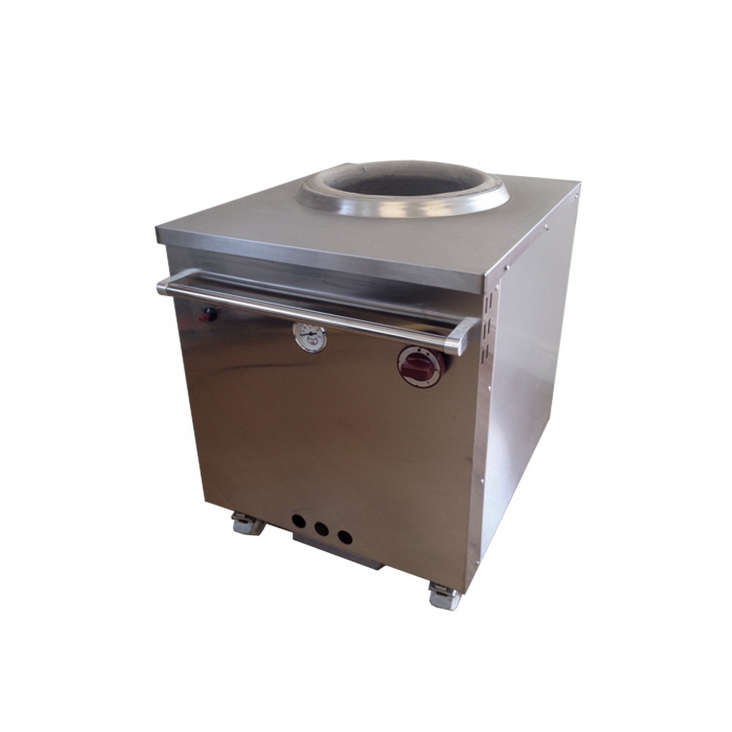
For an Indian, Pakistani or oriental concept restaurant wanting to stand out, integrating a traditional tandoor oven radically changes the customer experience. This is not an industrial production unit: it is the tool that enables you to serve freshly flame-cooked naan, with the inimitable texture that only clay cooking produces — crispy on the outside, soft inside, slightly smoky. The small model is the ideal entry point for testing this production, even with limited kitchen space.
Why artisan clay makes all the difference
The interior clay bowl is not an economical substitute material — it is what defines tandoor cooking. Clay absorbs and releases heat progressively and evenly, without cold spots or overheated zones. The result: naans stuck to the wall cook evenly in 60 to 90 seconds, without intensive monitoring. Meats on skewers benefit from gentle, constant radiant heat that preserves the juiciness at the core while caramelising the surface.
The Pakistani artisan manufacturing of this oven guarantees clay quality and thermal resistance superior to industrially manufactured models. With regular maintenance (complete drying after each service, progressive preheating), the service life exceeds 10 years.
Who is this format for?
- Indian and Pakistani restaurants with moderate throughput: a cooking surface suited for regular orders without over-investing
- Restaurants wishing to add naans to their menu without making it their core production — the compact size (800mm wide) fits into a standard kitchen
- Food trucks and dark kitchens wanting to differentiate with an artisan flatbread offering
- Kebab shops and oriental snack bars seeking an alternative to industrial bread for their sandwiches
If your naan throughput regularly exceeds the capacity of continuous service, or if your restaurant has a large dining room with high demand for fresh bread, the large model (id 111, €2,690 excl. VAT, 600mm opening) is more suitable.
Technical Specifications
- Dimensions (W×H×D): 800×810×710 mm
- Weight: 180 kg
- Opening: Approx. 500 mm
- Fuel: Natural gas or propane
- Power: 14 kW
- Natural gas: Max. 14 kW (1.47 m³/h) · Min. 2.25 kW (0.23 m³/h) · Pressure 20 mbar · Injector 2.95 mm
- Propane: Max. 14 kW (1 kg/h) · Min. 2.25 kW (0.16 kg/h) · Pressure 37 mbar · Injector 1.85 mm
- Exterior: Food-grade stainless steel
- Interior: Pakistani artisan clay
What's Included
- Complete tandoor oven with clay bowl
- Skewers for meat and fish cooking
- Lava stones included
- Complete start-up and maintenance manual
Small Model vs Large Model — which to choose?
| Criterion | Small Model (id 27) · €2,390 excl. VAT | Large Model (id 111) · €2,690 excl. VAT |
|---|
| Dimensions (W×H×D) | 800×810×710 mm | 1,000×1,010×910 mm |
| Weight | 180 kg | 220 kg |
| Opening | ~500 mm | ~600 mm |
| Cooking surface | Standard | Superior (~25% more) |
| Recommended use | Moderate throughput, small kitchen, concept testing | High throughput, high naan demand |
What restaurateurs ask
- To open an Indian or Pakistani restaurant, which tandoor oven to choose first?
- The traditional small model (€2,390 excl. VAT) is the recommended entry point for a start-up restaurant: manageable size, accessible investment, authentic clay cooking. It is suitable for 60 to 80 naans per lunch or dinner service. If your menu is centred on naans and you expect a dining room of more than 40 high-throughput covers, opt for the large model.
- Does a professional tandoor oven only cook naans, or also rotis and chapatis?
- The traditional tandoor oven cooks naans (leavened white wheat bread), rotis (unleavened wholemeal bread), chapatis (thin flatbread), and marinated meat pieces on skewers (chicken tandoori, seekh kebab) equally well. The radiant heat from the clay suits anything cooked in contact with the wall or suspended in the cooking chamber.
- Clay tandoor oven or automatic naan oven: what is the concrete difference?
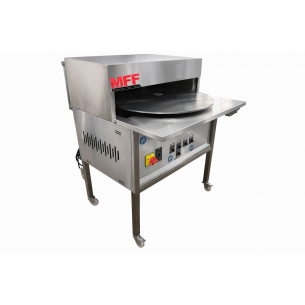
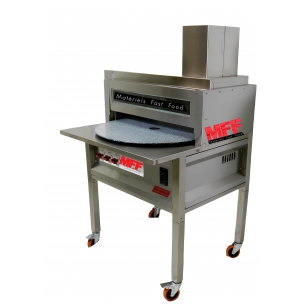
- The traditional clay oven gives authentic cooking — the naan sticks to the wall and takes on a slight smoky texture that the automatic oven does not exactly replicate. However, the automatic rotary oven (300 naan/h) is much faster and requires no specialist labour. For a fine dining Indian restaurant that values authenticity, the traditional model. For a high-throughput restaurant or catering service, the rotary model.
Delivery to France and Europe. Showroom available by appointment for a cooking demonstration.