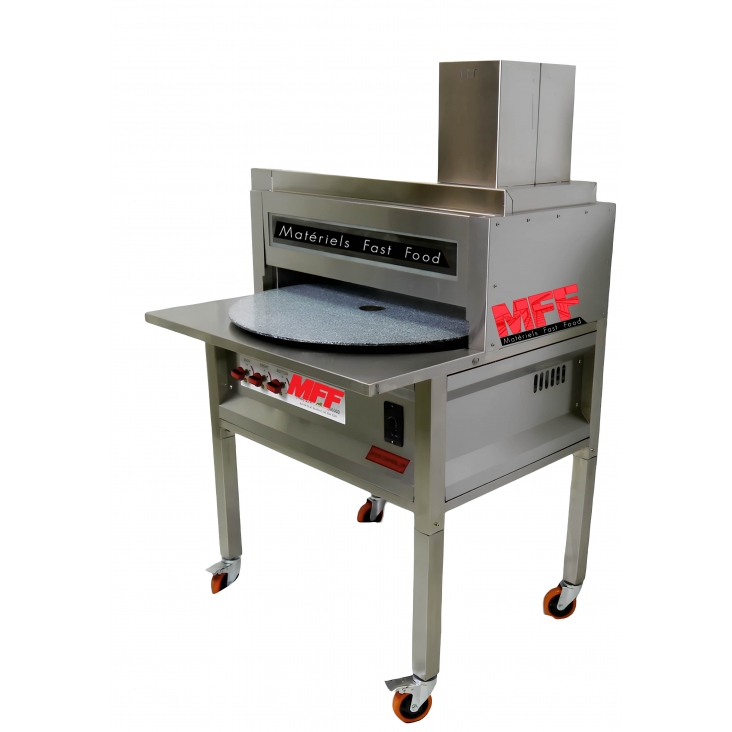
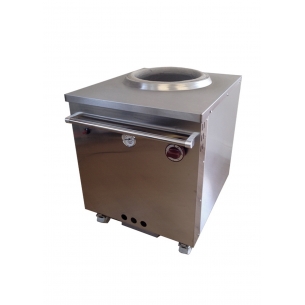
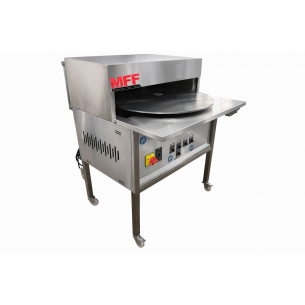
When the volume of naans and flatbreads to produce exceeds what a traditional oven can handle with one operator, the automatic gas rotary tandoor oven takes over. Its motorised rotating plate removes the dependency on artisan technique and raises production capacity to 300 naans per hour — a throughput that even the busiest Indian restaurants only reach during intense peak hours. All with just 5 minutes of preheating and fully automatic ignition.
What automatic rotation changes
In a traditional oven, the operator manages the rotation of naans to avoid uneven cooking. This requires experience: too early, the dough does not stick to the wall; too late, the exposed side burns. The automatic rotary system eliminates this variable. The naans rotate at constant speed on the motorised plate, uniformly exposed to heat from the 3 burners — 2 independently controlled in the high position, 1 underneath — for even cooking across the entire surface.
- Consistent results regardless of the team's skill level
- No intensive monitoring required during cooking
- Continuous throughput without interruption between batches
- Ideal for kitchens with frequent staff turnover
Who is this model for?
- High-volume Indian and Pakistani restaurants: full lunch and dinner service, extensive naan menus
- Takeaways and dark kitchens producing flatbreads for multiple brands simultaneously
- Premium kebabs wanting to offer authentic flame-baked bread in large quantities
- Oriental caterers preparing buffets or mass deliveries
For establishments without gas access (shopping centres, dense urban areas), see the electric model (7,990€ ex-VAT, same performance).
Technical specifications
- Dimensions: 1,000×820×1,170 mm (L×D×H)
- Weight: 163 kg
- Capacity: 300 naan / roti / chapati per hour
- Preheat: 5 minutes
- Burners: 3 — 2 gas with individual control + 1 underneath the structure
- Ignition: Automatic
- Total power: 26.5 kW
- Natural gas: 20 mbar
- LPG / Propane: 37 mbar
- Gas connection: 1/2" fitting
- Legs: Removable
- Required door width: 70 cm minimum
Gas vs Electric — comparison
| Criteria | Automatic Gas · 6,990€ ex-VAT | Automatic Electric · 7,990€ ex-VAT |
|---|
| Power supply | Natural gas or LPG | Three-phase electric 440V |
| Power | 26.5 kW | 10 kW |
| Production | 300 naan/hour | 300 naan/hour |
| Preheat | 5 minutes | Longer (electric heating) |
| Energy cost | Generally more economical | Depends on local electricity tariff |
| Installation | Gas connection required | Three-phase — no gas needed |
| Safety | Safety burners | No open flame |
| Recommended for | Restaurants with gas access, high volume | Shopping centres, food courts, dark kitchens |
What restaurateurs ask
- 300 naans per hour: what type of restaurant can justify this throughput?
- 300 naan/h corresponds to 5 naans per minute in continuous production. This throughput is suited to high-footfall restaurants serving naans as a systematic accompaniment (75 to 100% of tables), food courts with a visible flatbread station, dark kitchens producing for multiple points of sale, and event caterers for weddings or banquets. For an Indian restaurant with 40 to 60 covers at normal volume, this output exceeds requirements.
- Gas rotary vs electric rotary: how to choose for your restaurant?
- The gas rotary oven (6,990€ ex-VAT) is ideal for restaurants with an existing gas connection looking to limit three-phase electricity consumption. Its total power of 26.5 kW allows rapid temperature build-up (5-minute preheat). The electric rotary (7,990€ ex-VAT) is preferable for food courts, shopping centres and dark kitchens where gas is prohibited or unavailable — without open flame, it meets the specific safety requirements of these environments.
- Does an automatic rotary oven produce the same naan as a traditional clay tandoor?
- The result is similar but not identical. The rotary oven produces a homogeneous, consistent and reproducible naan — ideal for volume production with multiple operators. The traditional clay oven provides a slight smoky texture and natural variation (each naan is unique) that is a sought-after quality in Indian gastronomy. For a restaurateur who values authenticity on their menu, the rotary is perceived as industrial; for a high-volume restaurant, the consistency of the rotary is a decisive operational advantage.
Delivery France and Europe. Showroom available by appointment.