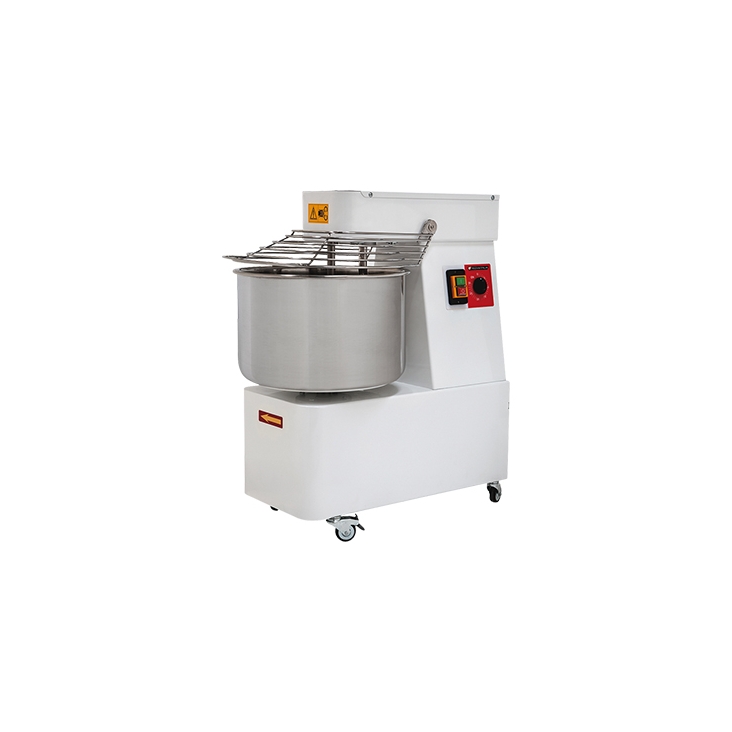
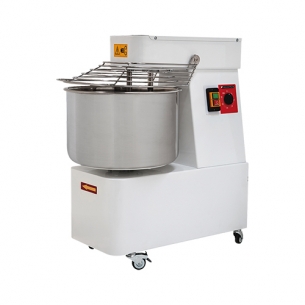
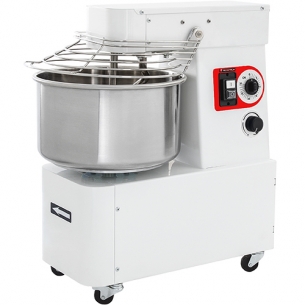
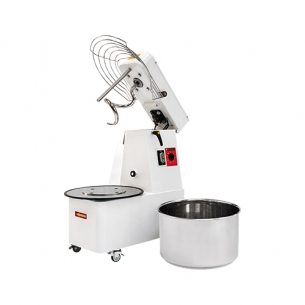
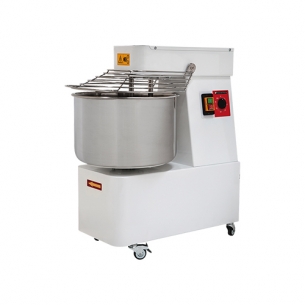
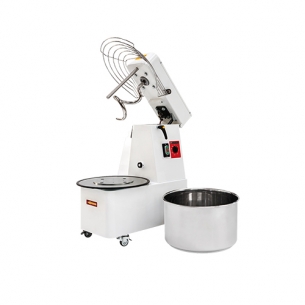
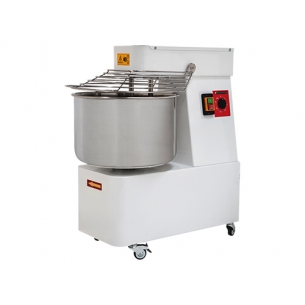
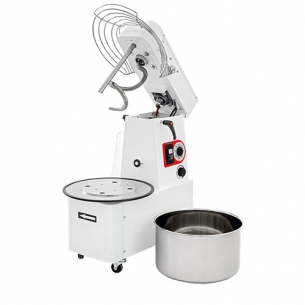
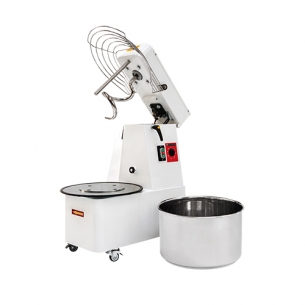
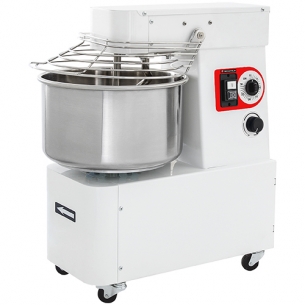
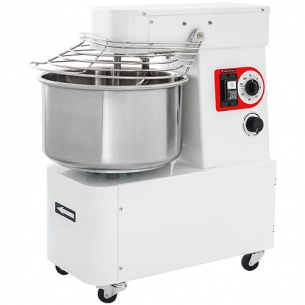
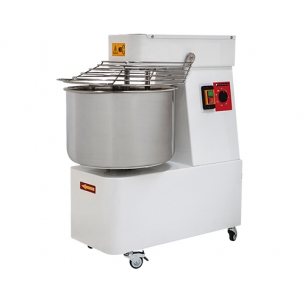
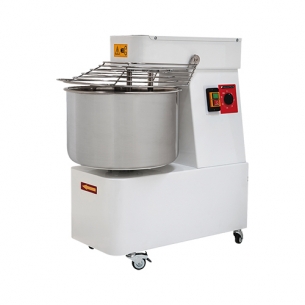
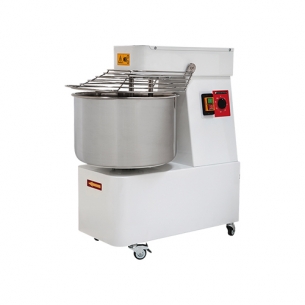
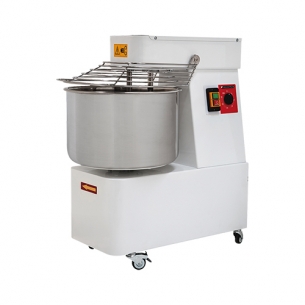
The IBM30 spiral dough mixer is the 3-phase 400V version of the 32 L fixed-head range. Same dimensions as the IBM20 (440×750×810 mm), same 32-litre capacity, same 1300 W power — but a three-phase 400V supply aimed at professional kitchens whose electrical board is entirely on TRI. At €2,010, i.e. €350 more than the single-phase IBM20, the IBM30 is the logical choice for establishments whose electrical installation is 3-phase 400V and who want a mixer in step with the rest of their kitchen equipment.
3-phase 400V: why it matters in a professional kitchen
In a professional kitchen fully equipped on 3-phase 400V — combi oven, industrial fryer, professional range — the question of appliance power supply is not trivial. A single-phase appliance plugged into a three-phase board needs an adapter or a single-phase branch circuit, which can create load imbalances on the board. A natively three-phase appliance connects directly to the board with no intermediary and distributes evenly across the three phases.
For a 1300 W motor, the difference between single- and three-phase is also noticeable in start-up behaviour: a three-phase motor starts more gradually, without the current peak typical of single-phase starts on dense doughs. At full load — dense bread dough, kneading 20 kg in progress — the three-phase motor holds a more stable rotation speed and suffers less heating over a long kneading session.
If your installation is single-phase 230V, the IBM20 (€1,660) is identical in performance and is the suitable solution. If your kitchen is on three-phase, the IBM30 integrates natively with no adaptation.
32 litres fixed head: continuous production
The 32-litre bowl kneads about 20 kg of pizza dough per batch at standard hydration (60-65%). In 10 to 15 minutes of kneading per batch, a 45-minute prep session produces 40 to 50 kg of dough — enough to prepare 150 to 180 balls of 280 g for a full service. For a pizzeria of 60 to 90 covers, this capacity covers the entire prep in two batches.
The fixed head guarantees continuous-flow production: you remove the dough, reload, restart with no mechanism to handle. No pivot to maintain, no raising seal to watch — the monobloc structure is built to last in repetitive production environments. It is the operating mode of kitchens with a stabilised process: same recipe, same hydration, same kneading time, batch after batch.
For which establishment
The IBM30 is built for fully three-phase professional kitchens: restaurants, pizzerias or central kitchens whose entire equipment is powered on 400V three-phase. It is also relevant for establishments in the process of equipping who are building their kitchen from scratch in 3-phase — in that case, choosing the IBM30 from the start avoids having to manage single-phase exceptions in a three-phase board.
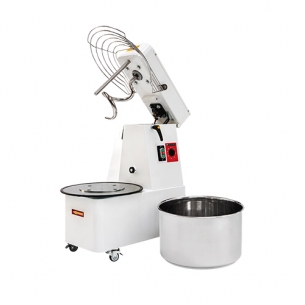
If production volume regularly exceeds 80 kg of dough per service, the 41 L models (IBT30 single-phase or IBM40 three-phase) offer a more suitable capacity. If bowl-handling flexibility matters, the raising-head models (IMR30, IRV30) better meet that need. The IBM30 remains the reference three-phase fixed-head mixer for kitchens wanting the simplicity and robustness of a native three-phase supply.
Technical specifications
| Reference | IBM30 |
|---|
| Type | Fixed-head spiral mixer, fixed bowl |
|---|
| Bowl capacity | 32 litres |
|---|
| Power | 1300 W |
|---|
| Supply | 3-phase 400V |
|---|
| Dimensions (W × D × H) | 440 × 750 × 810 mm |
|---|
| Price excl. VAT | €2,010 |
|---|
IBM20 vs IBM30: single-phase or three-phase?
| Criterion | IBM20 (single-phase) | IBM30 (3-phase) |
|---|
| Capacity | 32 L | 32 L |
| Power | 1300 W | 1300 W |
| Supply | 230V single-phase | 3-phase 400V |
| Dimensions | 440×750×810 mm | 440×750×810 mm |
| Connection | Standard 16 A socket | 3-phase 400V board |
| Motor start | Standard single-phase | More gradual (3-phase) |
| Price excl. VAT | €1,660 | €2,010 |
What restaurateurs ask
- How do I know if my kitchen is 3-phase 400V or single-phase 230V?
- Look at your electrical board: a 3-phase 400V board has four wires (three phases + neutral) and four-pole breakers. A single-phase 230V board has two wires (phase + neutral) and two-pole breakers. If in doubt, ask your electrician or the premises owner — the board clearly shows the supply type. Most new professional kitchens are three-phase; small premises and low-cost renovated kitchens may be single-phase.
- Can a 3-phase 400V mixer be plugged into a single-phase 230V board?
- No — three-phase appliances need a three-phase 400V supply. Plugging a three-phase appliance into a 230V single-phase socket can irreversibly damage the motor. If your installation is single-phase, choose the IBM20 (230V). If you are equipping a new kitchen, planning a three-phase board from the start is an investment that simplifies equipment choice over time.
- Is the 3-phase IBM30 more powerful than the single-phase IBM20 at the same 1300 W?
- The nominal power is identical (1300 W in both cases). It is not the power that differs, it is the quality of the electrical supply. A three-phase motor on a 1300 W load benefits from a more regular start torque and better load hold on very dense doughs. In practice, for standard use (60-65% hydration pizza dough), the difference is small. It becomes noticeable on very dense doughs or long kneading sessions.
- What is the difference between the IBM30 (32 L 3-phase) and the IBM40 (41 L 3-phase)?
- The IBM40 offers 41 litres of capacity (about 25 kg of dough per batch) versus 32 litres for the IBM30 (20 kg). Both are 3-phase 400V, 1300 W, fixed head. The IBM40 is wider (480×820 mm vs 440×750 mm) and more expensive (€2,250 vs €2,010). If your production volume regularly exceeds 60 pizzas per service in one batch, the IBM40 is the right choice. Below that, the IBM30 is enough and more compact.
3-phase 400V connection to be arranged by your electrician before installation. Delivery on request — contact us for lead times and conditions via the contact form.
MFF Guarantee & After-Sales: 1-year manufacturer guarantee, extended guarantee available. MFF technical support and spare parts. Delivery 48–72h mainland France.