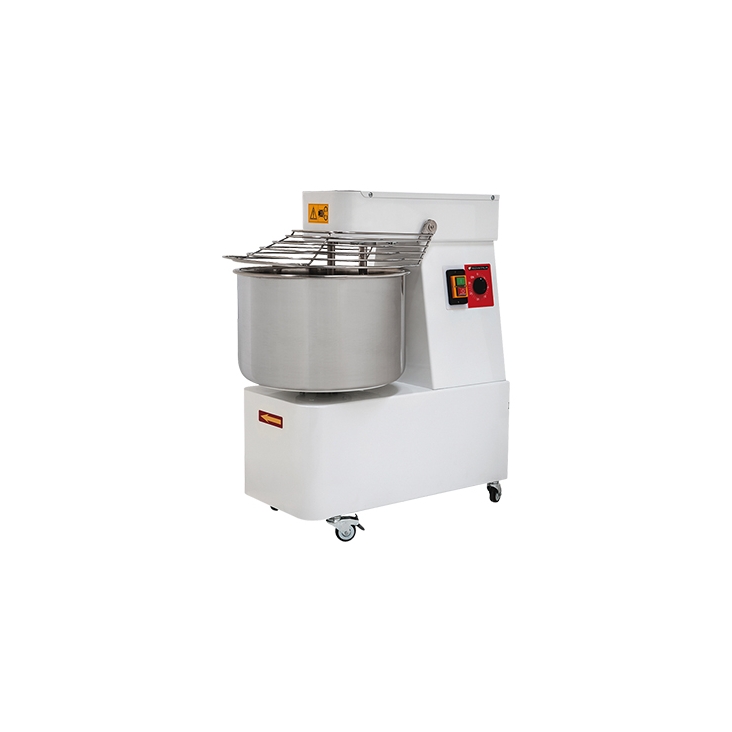
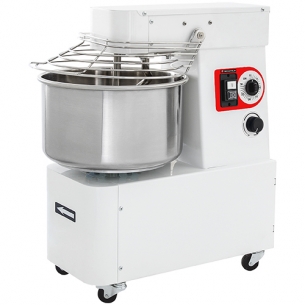
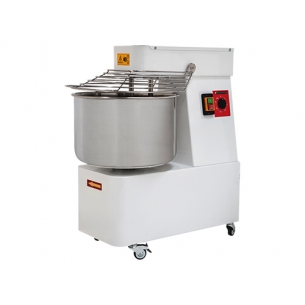
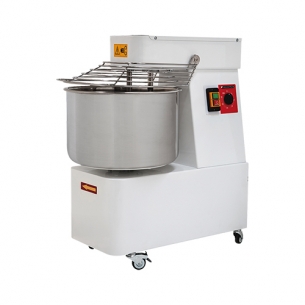
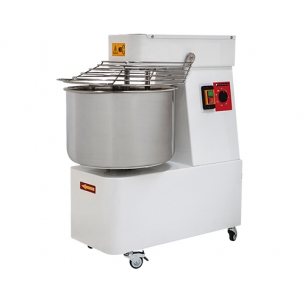
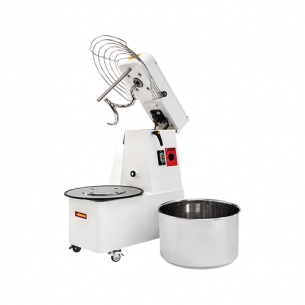
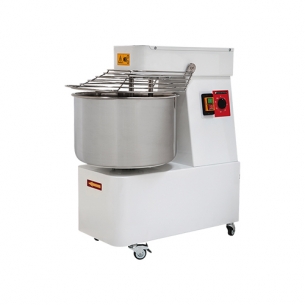
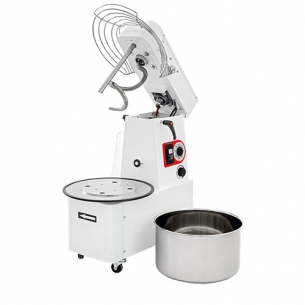
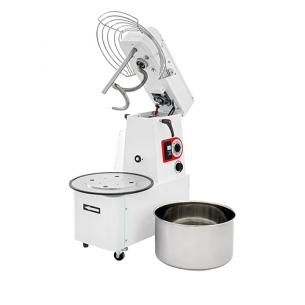
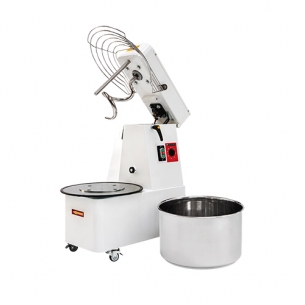
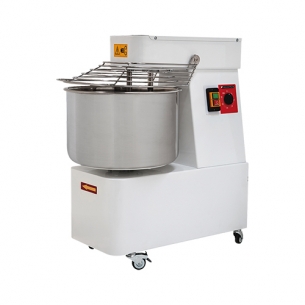
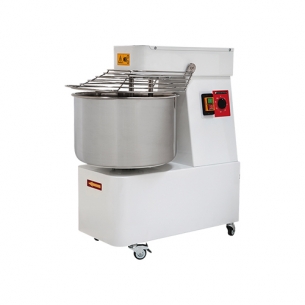
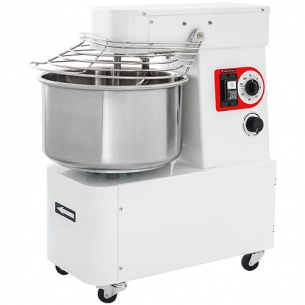
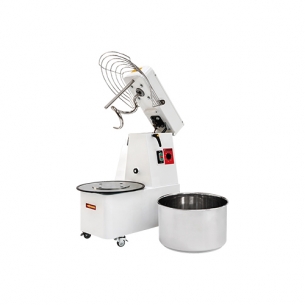
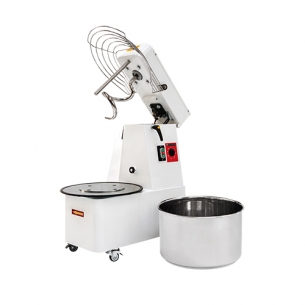
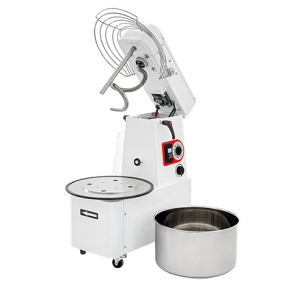
The IBM20 spiral dough mixer is the entry model of the fixed-head range: a 32-litre fixed bowl, 1300 W, in a 440×750×810 mm format. At €1,660, it is the most affordable mixer of the whole spiral range — and the logical choice for the pizzeria starting out, the snack bar adding pizza to its menu, or the restaurateur bringing dough production back in-house without over-investing. The fixed head — a monobloc body with no moving parts on top — guarantees an industrial robustness suited to repetitive production over the length of a service.
Fixed head: robustness in repetitive production
In a fixed-head spiral mixer, the head mechanism is an integral part of the machine body — no pivot, no raising mechanism, no moving seals on the upper section. This monobloc design has two direct consequences: structural rigidity is maximal (no parasitic vibration from a raising mechanism), and long-term durability is higher because there are fewer mechanical wear parts.
In practice, the fixed-head mixer is designed for continuous-flow production: the pizzaiolo kneads a batch, removes the dough from the top or by tipping the bowl, reloads, restarts. No mechanism to handle between batches. This simplicity of use is especially valued in fast-paced kitchens where every minute counts during prep.
Historically, the fixed-head configuration is the most widespread in high-throughput pizzerias and industrial bakeries. It is the reference configuration for teams with a stabilised, repetitive production process — no need to move the bowl between batches.
32 litres: what production in practice
A 32-litre spiral mixer kneads about 20 kg of pizza dough per batch at standard hydration (60-65%). With a kneading time of 10 to 15 minutes per batch, you can run 3 to 4 batches per prep hour — i.e. 60 to 80 kg of dough in a single prep session. With 250 to 280 g dough balls per pizza, 20 kg of dough represents 70 to 80 balls, enough to cover a service of 50 to 80 pizzas in a single batch.
For a high-hydration dough (70-80%, Neapolitan style), the effective capacity drops to 14-16 kg per batch — the spiral needs space to work the sticky dough without tearing it. If your recipe is high-hydration and your service volume exceeds 60 pizzas, plan two batches or move up to a higher-capacity model (41 or 48 L).
For which establishment
The IBM20 is the mixer of openings and cost-rationalisations. A pizzeria creating its business and wanting to equip its kitchen without tying up €3,000 to €5,000 in kneading equipment. A snack outlet or hybrid restaurateur adding pizza to its offer without an industrial production approach. A restaurant deciding to make its own dough rather than buying ready-made balls — with 20 kg of homemade dough per batch, the margin on raw materials improves significantly.
If production volume regularly exceeds 80 kg of dough per service, or if the kitchen layout requires moving the bowl for shaping and cleaning, the raising-head models (IBT50, IRV20) or the higher capacities (IBM30, IBM40, IBT40) will be better suited. At €1,660, the IBM20 remains the most accessible entry point of the whole professional range.
Technical specifications
| Reference | IBM20 |
|---|
| Type | Fixed-head spiral mixer, fixed bowl |
|---|
| Bowl capacity | 32 litres |
|---|
| Power | 1300 W |
|---|
| Dimensions (W × D × H) | 440 × 750 × 810 mm |
|---|
| Price excl. VAT | €1,660 |
|---|
What restaurateurs ask
- How many kg of pizza dough can a 32-litre mixer knead?
- For a standard-hydration pizza dough (60-65%), count about 20 kg of dough per batch in a 32-litre bowl. For a high-hydration dough (75-80% Neapolitan style), real capacity drops to 14-16 kg to keep quality kneading — the spiral needs space to work the sticky dough without losing its structure. With 250-280 g dough balls, 20 kg represents 70 to 80 pizzas in one batch.
- Fixed head or raising head: which to choose for my pizzeria?
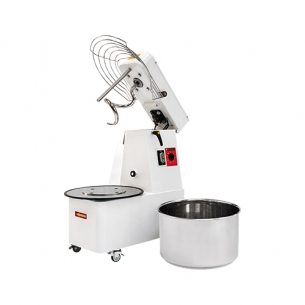
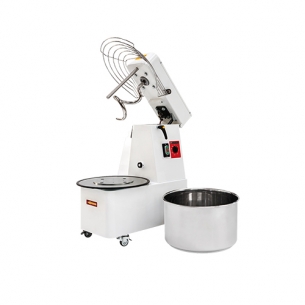
- The fixed head is ideal if your process is stabilised (same recipe, same hydration, same ball format) and you produce in continuous flow with no need to move the bowl. The raising head (IBT50, IRV20, IMR models…) is preferable if you alternate between different dough types, if frequent cleaning between productions is a constraint, or if you need to carry the bowl to the shaping worktop. The fixed head is more robust and cheaper; the raising head is more flexible and more hygienic.
- Is the IBM20 compatible with 230V single-phase, or do I need three-phase?
- The IBM20 is available in a 230V single-phase version and a 400V three-phase version — contact us to confirm the version available for your electrical installation. At 1300 W, the single-phase version is compatible with a standard 16 A supply with no dedicated circuit. The 3-phase 400V version is preferable for professional kitchens already fitted with a three-phase board, as it offers a softer start and a more regular load rise on dense doughs.
- Can this mixer be used for bakery or viennoiserie, not only pizza?
- Yes — the spiral is the universal kneading tool for professionals. It is perfectly suited to bread, brioche, focaccia, and even laminated yeast dough. The main difference from a planetary mixer: the spiral mixer is optimised for large quantities and dense, low-water doughs. For light preparations (sponge, meringue, whipped cream), the planetary mixer remains the appropriate tool.
Delivery on request — contact us to check lead times and conditions for your area via the contact form for any question before ordering.
MFF Guarantee & After-Sales: 1-year manufacturer guarantee, extended guarantee available. MFF technical support and spare parts. Delivery 48–72h mainland France.