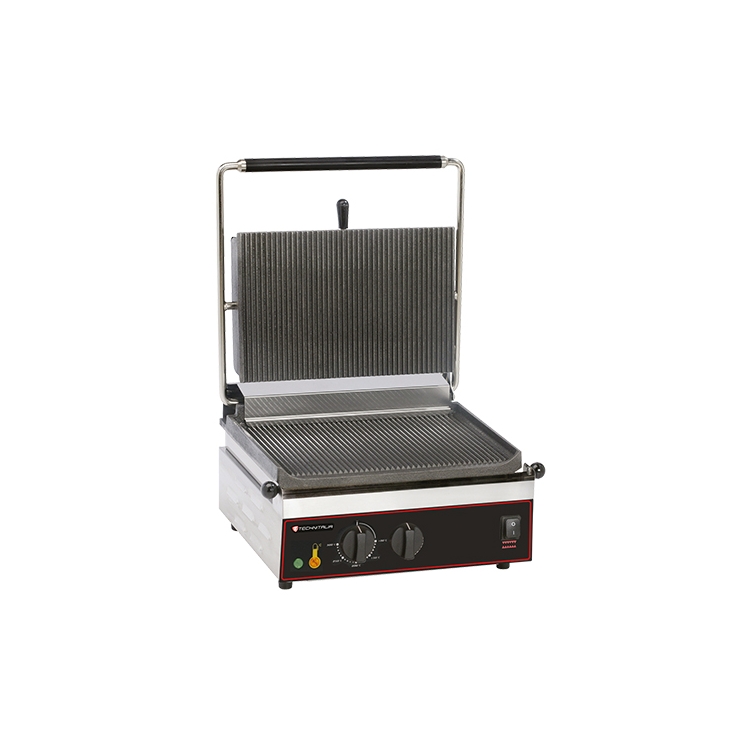
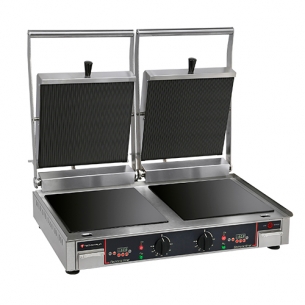
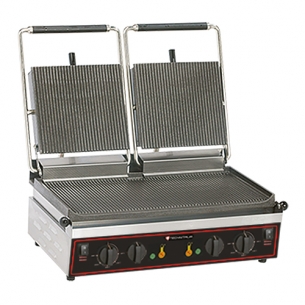
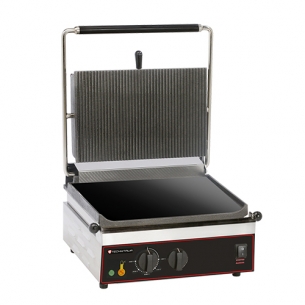
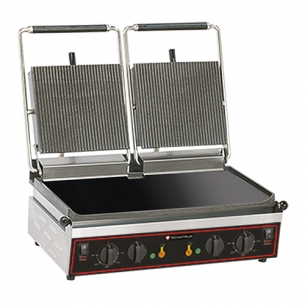
The difference between a panini ribbed on one side and a panini ribbed on both is visible from the first bite — and even more in the presentation. The single ribbed/ribbed cast-iron panini grill 3 kW is the model for establishments that want their sandwich to tell a story: crossed grill marks on both sides, contrasted texture, visible caramelisation over the whole surface. A compact 430 mm format on single-phase 230V supply, accessible to all professional kitchens with no installation constraint.
For which establishment?
This single ribbed/ribbed panini grill is chosen by establishments for which the sandwich's presentation is part of the experience: café-restaurants with paninis displayed in a refrigerated window before hot service, sandwich shops that present paninis cut in half and plated, hotel-restaurants with breakfast service where paninis are prepared in view of the customer. When the sandwich is open and presented cut-side up, the grill marks on both sides are visible — and they immediately signal careful cooking rather than mere reheating.
It is also the preferred model for grilled wraps and corn tortillas, whose two sides pass under direct heat and gain texture and presentation with a ribbed plate on each side. The standard single-phase 230V supply allows installation in any professional kitchen with no specific electrical work.
Cast aluminium: the right compromise between inertia and lightness
The plates of this panini grill are cast aluminium — a technical nuance that sets this model apart from heavy traditional cast irons. Cast aluminium combines several advantages:
- Lightness: 14 kg for this model, versus 20+ kg for a classic cast iron of the same surface — easier handling for cleaning and moving
- High thermal conductivity: aluminium conducts heat better than iron — faster and more even heating from the moment it warms up
- Correct inertia: less inertia than cast iron, but enough to hold temperature during successive loadings in moderate service
- Flat surface: the manufacturing precision of cast aluminium guarantees perfectly flat plates from delivery, with no long break-in or seasoning
The ribbed surface of both plates ensures the Maillard reaction occurs in direct contact on both sides, with the characteristic grilled aromas that smooth plates cannot reproduce.
Technical specifications
| Parameter | Value |
|---|
| Energy | Electric — single-phase 230V |
| Power | 3 kW |
| Cooking zone | Single |
| Plates | Cast aluminium: ribbed + ribbed |
| Cooking surface (W × D) | 430 × 385 mm |
| Dimensions (W × D × H) | 430 × 385 × 220 mm |
| Weight | 14 kg |
| Drip tray | Removable |
Single ribbed/ribbed vs single ribbed/smooth: the right choice by use
| Criterion | RR Ribbed/Ribbed (this model) | RS Ribbed/Smooth |
|---|
| Grill marks | Top AND bottom | Top only |
| "Grilled" presentation | Maximum — 2 marked sides | Partial — 1 marked side |
| Contrasted texture | Both sides | Top only |
| Soft or fragile breads | May stick slightly | Better hold underneath |
| Wraps and thin tortillas | Optimal | Good |
| Contact heat below | By points (ribs) | Even |
| Price excl. VAT | €590 | €590 |
Same price, two philosophies: ribbed/ribbed for presentation and full grilled texture; ribbed/smooth for maximum versatility and fragile breads. The choice depends on the dominant sandwich type on the menu.
What restaurateurs ask
- Why do two ribbed plates give a better result on wraps?
- A wrap is a thin, supple flour tortilla. On a smooth plate below, the tortilla heats evenly but has no marking. On a ribbed plate below, the ribs create direct-contact zones that grill the tortilla — it becomes slightly crisp, more appetising, and the grill marks give a visual signal of proper cooking rather than reheating. For grilled wraps to order, double-ribbed is the standard of quality sandwich shops.
- Do the removable drip-tray parts go in the dishwasher?
- The grease drip tray is removable and washes easily in hot water. The cast-aluminium plates, however, do not go in the dishwasher (oxidation and warping risk). They clean while warm (warm plates, not boiling) with a spatula for residues, then a damp cloth, and are protected with a film of food oil after drying.
- Does the ribbed/ribbed presentation justify the same price as a ribbed/smooth?
- Both models are at the same price (€590 excl. VAT). The choice is therefore not budgetary but technical and aesthetic. If your menu includes wraps, plated ciabatta paninis or sandwiches visible in a window with both sides showing, ribbed/ribbed adds higher perceived value at no extra cost. If your production includes brioche breads, focaccias or delicate sandwiches, ribbed/smooth will be safer.
- What working temperature for a cast-iron panini grill in service?
- The standard working temperature of a professional panini grill is 180 to 220°C depending on bread type. Ciabatta-type bread: 200-220°C for 3 to 4 minutes. Sandwich loaf or soft bread: 170-190°C for 2 to 3 minutes (higher burn risk). Wheat-tortilla wrap: 190-210°C for 2 to 3 minutes. Set the thermostat at the start of service, let the grill heat up 10 minutes before first use, then hold the setting for the whole service.
Hands-on training included on delivery. Standard delivery. To compare this model with the ribbed/smooth or our double formats, our technical team is available via the contact form.
MFF Guarantee & After-Sales: 1-year manufacturer guarantee, extended guarantee available. MFF technical support and spare parts. Delivery 48–72h mainland France.