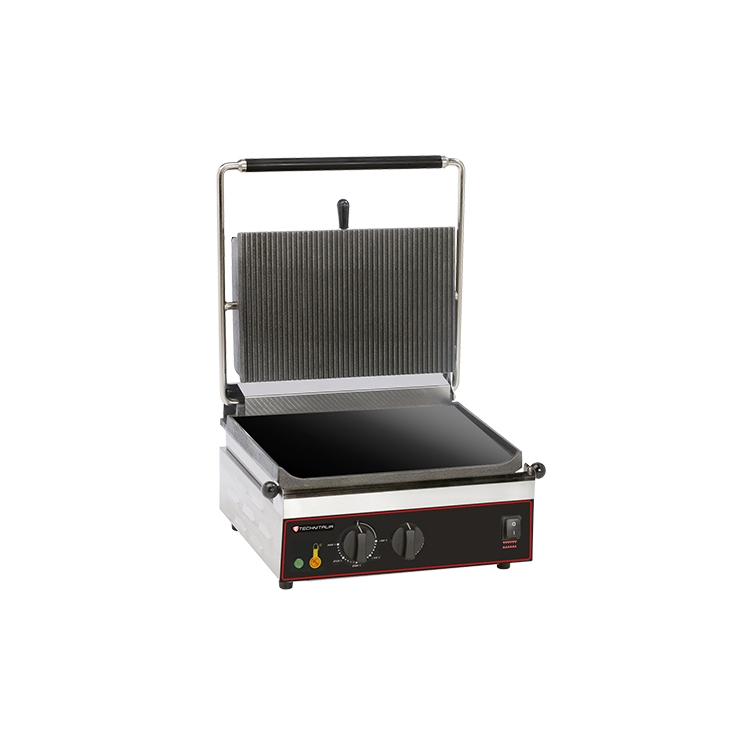
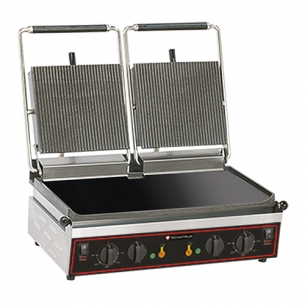
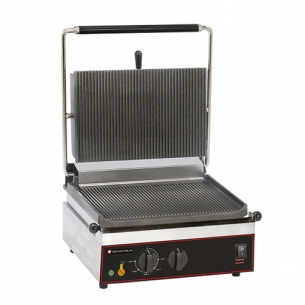
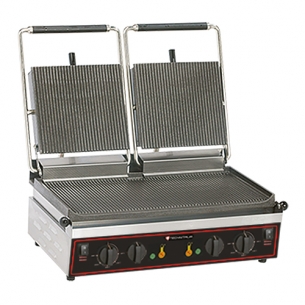
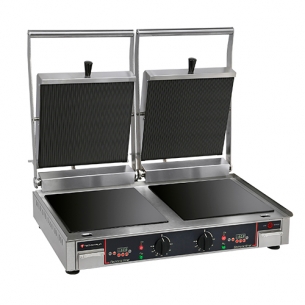
For the great majority of restaurants, cafés and snacks that serve paninis in service, the single cast-iron panini grill 430 mm 3 kW is the reference appliance. Neither too large nor too powerful: a 430 × 385 mm plate that handles 2 to 3 paninis at once, a 3 kW power on single-phase 230V that installs in any professional kitchen with no three-phase, and ribbed/smooth cast-iron plates that combine the look of the grill and the even heat of contact. The standard entry into professional panini grilling.
For which establishment?
This single cast-iron 430 mm panini grill suits all establishments serving 15 to 40 paninis per service with no three-phase available: café-restaurants with a panini lunch deal, bistros with a hot-sandwich menu, hotel-restaurants with hot breakfast to order, delis with a catering corner, 230V food trucks. The single-phase 230V supply is its main advantage over the double cast-iron models: no installation constraint, no electrician required, immediate connection to an existing 20A circuit.
For kitchens starting out and not yet sure what panini volume they will reach, this model is also the right first appliance. If throughput exceeds capacity (more than 40 paninis/service regularly), moving up to the double or the glass-ceramic can be done with confidence — the single stays as a second appliance or is easily resold.
Cast iron: thermal inertia as a service advantage
Cast iron is one of the materials that best holds heat once up to temperature. In a panini-grill service context, this translates concretely into cooking consistency from one sandwich to the next, even in fast succession:
- Opening the grill → the cast-iron plate loses less heat than thin steel or aluminium plates
- Loading a cold sandwich → the bread's rise in temperature is absorbed by the cast-iron mass with no visible temperature "drop" in the result
- Cooking 5 paninis in succession → the 5th is as golden as the 1st if the times are respected
This is why cast iron remains the reference material of professional kitchens for grills, griddles and salamanders, despite maintenance slightly more demanding than a non-stick coating or a glass-ceramic surface.
Technical specifications
| Parameter | Value |
|---|
| Energy | Electric — single-phase 230V |
| Power | 3 kW |
| Cooking zone | Single |
| Plates | Cast iron: ribbed + smooth |
| Cooking surface (W × D) | 430 × 385 mm |
| Dimensions (W × D × H) | 430 × 385 × 220 mm |
| Weight | 13 kg |
Single mono vs single glass-ceramic vs double three-phase
| Criterion | Single Cast Iron 230V (this model) | Single Glass-Ceramic | Double Cast Iron Three-Phase |
|---|
| Power | 3 kW | 3 kW | 4 kW |
| Supply | 230V single-phase | 230V single-phase | 400V three-phase |
| Cooking surface | 430 × 385 mm | 390 × 600 mm | 600 × 385 mm |
| Paninis at once | 2 to 3 | 2 to 3 | 4 |
| Plate material | Cast iron | Glass-ceramic | Cast iron |
| Price excl. VAT | €590 | €1,360 | €820 |
What restaurateurs ask
- Is 3 kW on single-phase 230V enough to serve 25 paninis at peak?
- Yes — with a 3 to 5 minute cycle for 2 to 3 paninis, you get 25 to 40 paninis over a 2-hour service at a sustained pace. For 25 paninis over a compressed lunch service (90 minutes), the single 3 kW is at the high limit — plan to have the grill up to temperature 15 minutes before service to avoid late starts. Beyond 40 regular paninis per service, move up to the double.
- How to maintain the cast-iron plates of a panini grill day to day?
- Before first use: light oiling with a cloth followed by a gradual heat-up (30 minutes at 150°C). In service: never wash the plates with cold water when they are hot (crack risk). After service: degrease with a spatula on warm plates (50-60°C), wipe with a dry cloth, apply a film of food oil before storing. This protective oiling prevents oxidation between services.
- What is the difference between a panini grill and a griddle for cooking sandwiches?
- The panini grill is a two-plate appliance (top and bottom) that presses the sandwich between two hot surfaces — simultaneous cooking of both sides, sandwich hot through in 3 minutes. The griddle is a flat cooking surface (single side) where the sandwich is placed and turned by hand. For closed paninis to order, the panini grill is faster and more consistent. For open sandwiches or grilling with no compression, the griddle is more appropriate.
- Can this panini grill be used to grill meat as a griddle substitute?
- For thin escalopes (under 1.5 cm), flattened chicken breasts, or burger patties, yes. The compression of the two plates speeds cooking versus a single-sided griddle. For thick cuts or long cooking, the griddle or a contact meat grill will be more suitable — the panini grill is not designed to withstand the pressure of a thick cut that will not compress.
Hands-on training included on delivery. Standard delivery. To compare this model with our double or glass-ceramic range, our technical team replies via the contact form.
MFF Guarantee & After-Sales: 1-year manufacturer guarantee, extended guarantee available. MFF technical support and spare parts. Delivery 48–72h mainland France.