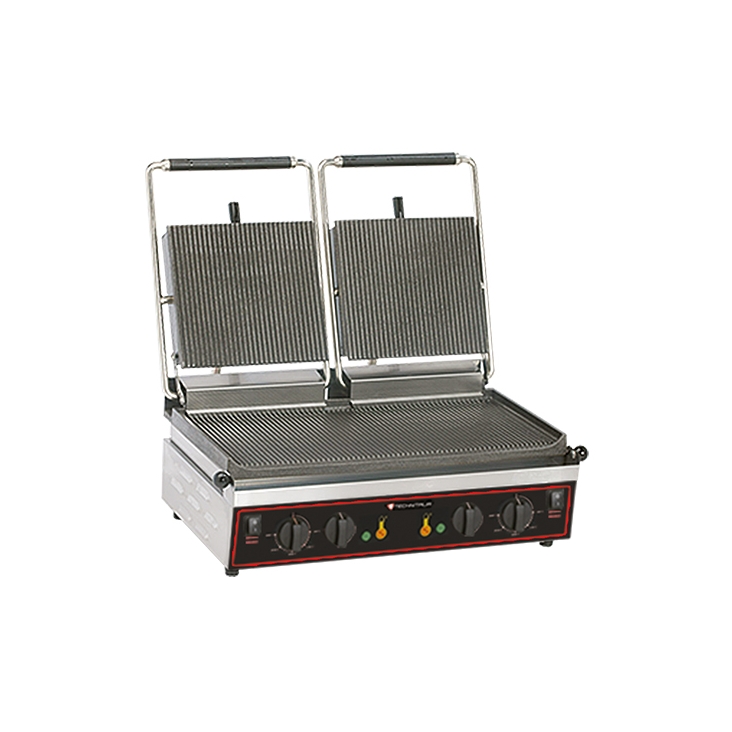
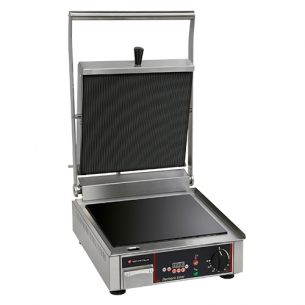
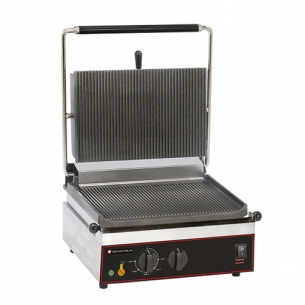
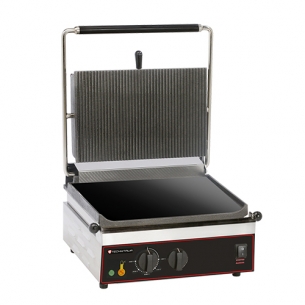
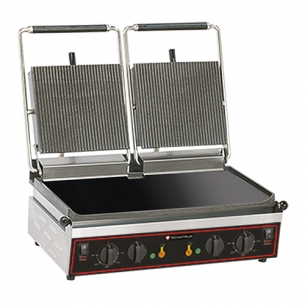
When the panini's presentation is part of the customer experience — sandwich cut in half and presented open, ciabatta marked on both sides visible in the window, grilled club sandwich plated — grill marks on a single side are no longer enough. The double ribbed/ribbed cast-iron panini grill 4 kW meets this need: two ribbed plates that mark the top and bottom of the sandwich simultaneously, in a 600 mm double format that handles 4 paninis in a single pass. The three-phase 400V supply is the installation prerequisite for this power.
⚠️ Prerequisite: three-phase 400V supply
This panini grill runs on a three-phase 400V supply. Before ordering, check the availability of three-phase in your professional kitchen. Three-phase is generally available in kitchens fitted with a professional consumer unit, but not systematically in every commercial premises. For kitchens without three-phase, our range of single-phase 230V grills covers the same uses with no specific installation constraint.
For which establishment?
This double ribbed/ribbed panini grill is the choice of establishments where presentation counts as much as pace: upmarket sandwich shops with display windows, bistro restaurants with a worked-out panini menu, caterers in delivery service where the sandwich will travel and must look appetising when cut, café-restaurants with plated panini deals. The two ribbed plates create an "authentic grilled" effect on all faces of the bread — when the panini is cut in half and stood up on the plate, both inner faces show the grill marks, reinforcing the quality perception.
It is also the equipment of kitchens that prepare grilled wraps and corn tortillas: these thin, flexible formats grill better with two ribbed plates that hold them flat and create regular marks on both sides, where a smooth plate below can leave one pale, unmarked face.
Double-ribbed plate: grill marks as a signature
Grill marks are not only aesthetic. They have a real impact on cooking and product perception:
- Local caramelisation: the ribs create high-temperature contact points that trigger the Maillard reaction — the brown bands have a slightly sweet, grilled taste distinct from the rest of the bread
- Contrasted texture: alternating crisp zones (on the ribs) and soft zones (between the ribs) — a more interesting texture than uniformly golden bread
- Quality signal: visible grill marks tell the customer the sandwich is grilled to order, not reheated or prepared in advance
- Grease drainage: the ribs let grease run off rather than staying in contact with the food — less greasy bread, cleaner service
The ribbed/ribbed version is recommended when all these qualities must be present on both sides — notably for grilled-ciabatta sandwiches cut for tasting or paninis presented open in the window.
Technical specifications
| Parameter | Value |
|---|
| Energy | Electric — three-phase 400V |
| Power | 4 kW |
| Cooking zones | Double (1 wide zone) |
| Plates | Cast iron: ribbed + ribbed |
| Cooking surface (W × D) | 600 × 385 mm |
| Dimensions (W × D × H) | 600 × 385 × 220 mm |
| Weight | 14 kg |
Ribbed/ribbed vs ribbed/smooth: choosing the right configuration
| Criterion | RR — Ribbed/Ribbed (this model) | RS — Ribbed/Smooth |
|---|
| Grill marks | Top AND bottom | Top only |
| Contact heat lower face | By points (ribs) | Even (full contact) |
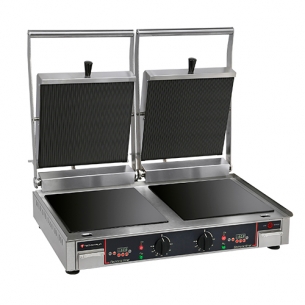
| Fragile or soft breads | May stick/mark unevenly | Better hold |
| Wraps and tortillas | Excellent | Good |
| Ciabatta and firm breads | Optimal | Optimal |
| "Grilled" presentation | Maximum on 2 sides | Marked on 1 side |
What restaurateurs ask
- Why choose double-ribbed rather than ribbed/smooth for a panini grill?
- If the presentation of the cut sandwich or the visual "grilled" quality on all faces is a selling point, double-ribbed stands out. If the priority is maximum versatility (fragile breads, focaccias, soft sandwiches that stick to ribs), ribbed/smooth offers more flexibility. For a sandwich shop with a fixed menu of ciabattas and wraps, double-ribbed is optimal.
- Do cast-iron plates need specific maintenance?
- Yes. Cast iron, unlike stainless steel or glass-ceramic, must be "seasoned" before first use (cloth oiling + gradual heat-up) and lightly oiled after each cleaning to prevent oxidation. In service, spatula degreasing at the end of service followed by a light film of oil preserves the plates. Well maintained, a cast-iron plate lasts 10 to 15 years and develops a natural patina that improves cooking.
- How to stop food sticking on the ribbed plates?
- Three precautions: (1) do not use the plates before they are fully up to temperature — a sandwich on cold plates sticks every time; (2) lightly brush the bread with oil or butter before loading for very soft breads; (3) do not open the grill during the first 30 seconds of cooking — the bread releases naturally once sufficiently seared.
- 4 kW three-phase for a double panini grill — is that a lot?
- For a double 600 mm cast-iron grill, 4 kW is the standard power to reach and hold a working temperature of 200-230°C. It is less powerful than the double glass-ceramic 6 kW model, but cast iron compensates with its thermal inertia: it keeps the heat between loadings more efficiently. On three-phase, the 4 kW power is distributed over 3 phases (about 1.3 kW per phase), which reduces the load on each phase of the network.
Hands-on training included on delivery. Pallet delivery with unloading. To confirm three-phase availability or compare with our single-phase models, our technical team replies free via the contact form.
MFF Guarantee & After-Sales: 1-year manufacturer guarantee, extended guarantee available. MFF technical support and spare parts. Delivery 48–72h mainland France.