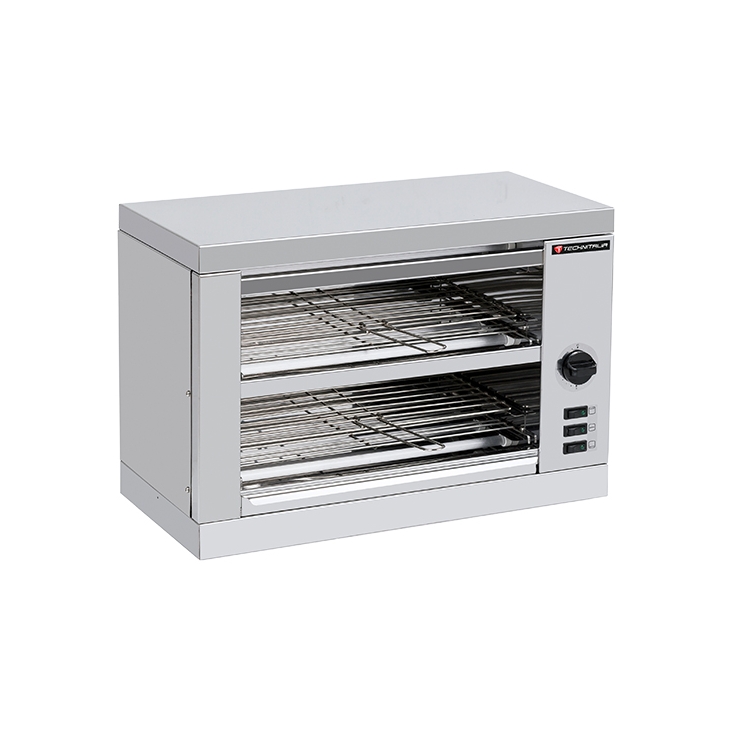
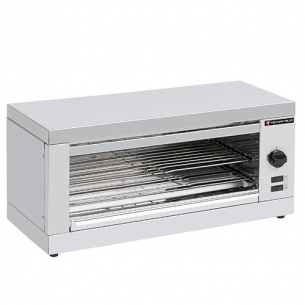
The electric 2-level toaster is the solution to double toast production without doubling worktop space. Two stacked 375 × 200 mm grilles, 3.6 kW (2 × 1.8 kW per level), the same footprint as the compact 1-level model (535 × 270 mm) — just 115 mm more in height (395 mm vs 280 mm). At €360 excl. VAT, the same price as the 1-level wide, the choice is simple: if toast volume exceeds one level's capacity, the 2 levels double the throughput without enlarging the installation.
For which establishment?
- High-volume sandwich shop at lunch: between noon and 2pm, an active sandwich shop can serve 30 to 60 sandwiches with toast. A single level (15–25 toasts/hour) creates a bottleneck. The 2 levels let you run two batches at once — one level heats while the other is loaded and reloaded.
- Bakery with counter toast sales: the morning toast service (7am–10am) with a queue of customers demands a continuous pace. The 2 levels allow continuous toasting — level 1 cooking, level 2 reloading, permanent alternation.
- Restaurant with structured brunch or breakfast service: when toasts are a central element of service (brunch plates, full breakfasts), the double grille lets you send toasts at once for a whole table rather than by rotation.
- Hotel with a busy breakfast buffet: in a self-service buffet, customers serve themselves. Two levels available at once cut waiting time and improve the experience.
Two levels, same footprint: how it works
The 2-level toaster principle is simple: two stacked grilles, each with its own element, run independently or at once. Two use modes in active service:
- Simultaneous mode: load both levels at once, start the heat — both batches are ready at the same time. Ideal to serve a full table with hot toasts at once.
- Alternating mode: while level 1 heats, load level 2; when level 1 is ready, empty and reload level 1 while level 2 heats. Continuous pace with no interruption — ideal for a flow sandwich-shop service.
The temperature setting can differ on each level — for example, level 1 at 180°C for sandwich loaf (gentle cooking), level 2 at 220°C for denser bagels. This flexibility is an advantage in a bakery with a varied bread assortment.
3.6 kW for 2 levels: consumption and installation
3.6 kW on single-phase 230V is about 15.6 A — check that the available socket circuit is rated for at least 16 A (standard in professional installations). If both levels run at once at full power, the 3.6 kW is drawn continuously for the cycle. In alternating mode (one level active at a time), consumption is 1.8 kW — within a standard 10/16 A socket gauge.
Technical specifications
| Parameter | Value |
|---|
| Type | Element toaster — 2 levels |
| Energy | Electric — single-phase 230V |
| Total power | 3.6 kW |
| Grille dimensions per level | 375 × 200 mm |
| Levels | 2 |
| Control | Temperature setting |
| Structure | Stainless steel |
| Overall dimensions | 535 × 270 × 395 mm |
| Weight | 23 kg |
| Price excl. VAT | €360 |
Comparison of the 4 element toasters
| Model | Grille | Levels | Footprint | Throughput | Price excl. VAT |
|---|
| 1 level compact | 375 × 200 mm | 1 | 535 × 270 mm | ~20 toasts/h | €300 |
| 1 level wide | 520 × 210 mm | 1 | 685 × 275 mm | ~20 toasts/h | €360 |
| 2 levels (this model) | 2 × 375 × 200 mm | 2 | 535 × 270 mm | ~40 toasts/h | €360 |
| 2 levels wide | 2 × 520 × 210 mm | 2 | 685 × 275 mm | ~40 toasts/h | €460 |
The 2-level model (€360) vs 1-level compact (€300): €60 more, doubles the throughput, same footprint. If the pace regularly exceeds 20 toasts/hour, the extra €60 pays back fast. If the bread format exceeds 35 cm, you must move to the wide model.
What restaurateurs ask
- Can a single level be used at a time to save energy?
- Yes. The two levels are independent — each has its own switch and element circuit. In light service (quiet morning, few orders), running just one level cuts consumption by 50% (1.8 kW instead of 3.6 kW) and element wear. At service peak, run both levels at once. This flexibility is an advantage for energy management.
- Can the two levels heat at different temperatures?
- Yes, if each level has its own thermostat (to check on the model received). One level at 180°C for sandwich loaf, another at 220°C for bagels or denser grain breads — this setup lets you serve two bread types at once with no adjustment between batches. In practice, most establishments set both levels to the same temperature to simplify service.
- Do the lower and upper level toasts come out at the same toast level?
- In principle yes, if both elements are identical and set to the same temperature. In practice, natural convection can create slight differences between the lower level (cooler, heat rises) and the upper level (hotter, rising-heat build-up). On a quality professional toaster, this gap is limited and not noticeable to the customer. For perfect consistency between levels, a slight temperature adjustment (5°C more on the lower level) may be needed after a few days of use.
- Is this 2-level model suited to burger buns?
- Yes, but not for XXL formats. The 375 × 200 mm grille holds a classic burger bun (10–13 cm diameter) — 2 to 3 buns at once per level, i.e. 4 to 6 buns per batch over the 2 levels. For smash burgers with 15 cm buns or wide 14 cm brioche breads, check the grille width (200 mm) is sufficient. For formats >15 cm, the 2-level wide model (520 × 210 mm grille, €460 excl. VAT) is the solution.
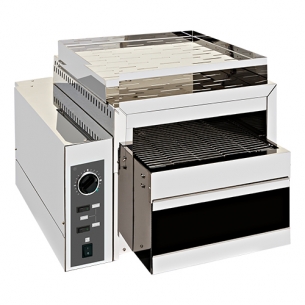
For long breads with 2 levels, see the 2-level wide (520 mm, €460 excl. VAT). For very high throughput (400 toasts/hour), see the conveyors (€1,560–1,680 excl. VAT). Our team is available via the contact form.
MFF Guarantee & After-Sales: 1-year manufacturer guarantee, extended guarantee available. MFF technical support and spare parts. Delivery 48–72h mainland France.