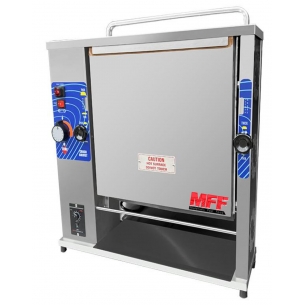
A Bread Warmer, Not a Toaster — the Key Difference
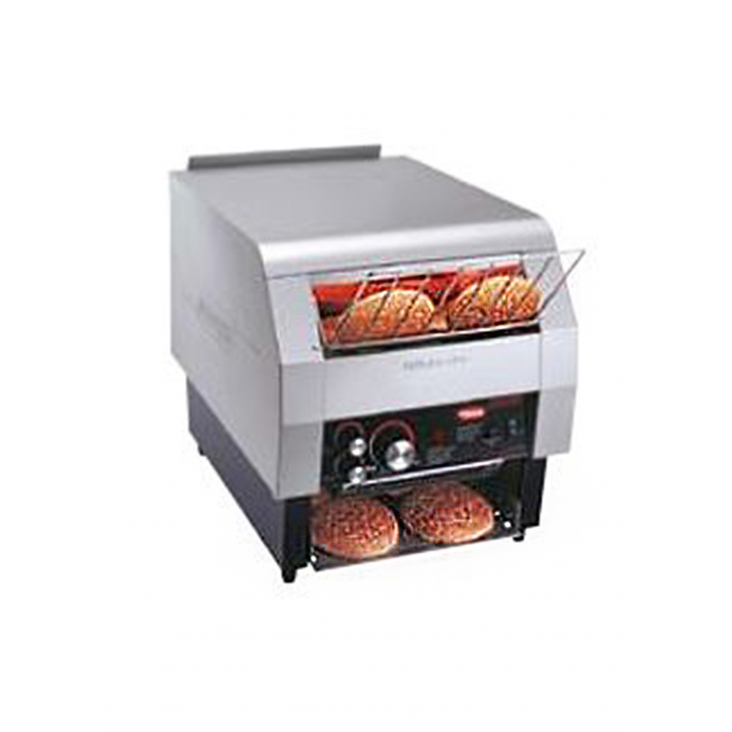
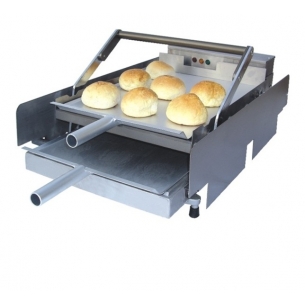
The Conveyor Bread Warmer is frequently confused with a conventional conveyor toaster. The distinction is fundamental: a toaster browns the bread surface through direct radiant heat, creating caramelisation and a crunchy crust. This machine does the opposite — it heats bread gently to a temperature that makes it warm and pleasant, without browning, without crisping the crust, without drying out the crumb. The bread exits warm, soft and exactly as it was when it went in, just at serving temperature.
This characteristic makes it the reference choice for fast-food restaurants, burger bars and catering operations using enriched soft breads — brioche buns, milk rolls, potato buns — that must reach the customer warm and pillow-soft. At 1,000 slices per hour on a 2.7 kW draw, it handles high-volume service with less energy than a full conveyor toaster.
Why This Machine Over a Contact Toaster?
- Soft enriched buns (brioche, milk bun, potato bun): these absorb moisture and become unpleasant when toasted — a conveyor warmer is the correct choice.
- Premium burger concepts: customers paying for a quality bun expect it warm and fluffy, not with a crispy shell that overpowers other textures.
- Cafeteria and hotel buffet service: warm bread and pastries at volume without cooking them further.
- Continuous high-volume production: 1,000 slices/h without an operator handling each piece individually.
- Energy efficiency: 2.7 kW versus 4–6 kW for equivalent-throughput contact or conveyor toasters.
For Which Establishments?
- Fast-food restaurants and burger bars using soft enriched buns — the segment where warming is the standard finish, not toasting.
- Hotel and catering breakfast services warming croissants, pastries and bread rolls at volume for buffet service.
- Sandwich bars and snack bars with paninis, baguettes and soft rolls that benefit from warming without the structural change that toasting produces.
- Ghost kitchens and delivery operations: a warmer keeps bread at serving temperature without the drying effect of a toaster.
- Staff canteens and corporate catering serving bread alongside hot meals at high throughput.
Technical Specifications
- Type
- Conveyor bread warmer (not a toaster)
- Capacity
- 1,000 slices/hour
- Power
- 2.7 kW
- Dimensions (W×D×H)
- 432 × 495 × 438 mm
- Weight
- 25 kg
- Installation
- Floor-standing on legs (included)
- Price
- €1,190 ex-VAT
- Delivery
- France and Europe
- Warranty
- 1 year
Bread Warmer vs Conveyor Toaster — Comparison
| Criterion | Conveyor Warmer (this model) | Conveyor Toaster |
|---|
| Effect on bread | Warms — stays soft | Browns — crisps surface |
| Best bread type | Soft enriched buns, brioche, pastries | Sourdough, baguette, artisan loaf |
| Power draw | 2.7 kW | 4–6 kW typically |
| Throughput | 1,000 slices/h | 700–1,200 slices/h (model dependent) |
| Caramelisation | None | Yes — toasted flavour |
Frequently Asked Questions
- Can it toast bread as well as warm it?
- No — this machine is specifically designed for warming, not toasting. If you need a unit that can do both, look at a conveyor toaster with adjustable belt speed. This warmer is optimised for soft and enriched breads that must not be browned.
- Can it handle artisan bread and baguettes?
- Yes, for warming only. If you need a toasted crust on baguettes or sourdough, a contact or conveyor toaster is more appropriate.
- What is included in delivery?
- The unit ships complete with legs. Standard delivery across France and Europe; contact us for installation support if required.
The Conveyor Bread Warmer is available for immediate delivery. Our team of fast-food equipment specialists is available to advise on the right bread-finishing solution for your concept and volume — contact us if you are unsure whether this model or a toaster is the better match for your operation.