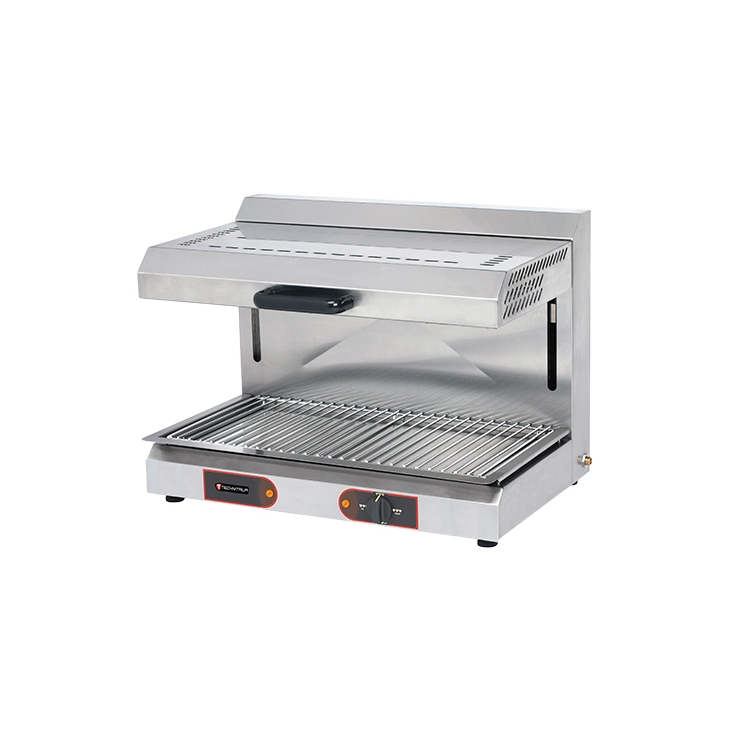
Not all salamanders are equal in front of a gratin dauphinois or a crème brûlée. The quartz salamander 800 mm stands out by the nature of its heating element: quartz elements that emit an even infrared, with no concentrated heat point. Result: even browning over the whole surface, edge to edge, without burning one corner of the plate while the other stays pale. For kitchens that treat finishing as a signature, quartz technology changes the visible result on the plate.
For which establishment?
This quartz salamander 800 mm is built for kitchens that care about gourmet finishing: bistronomic and gourmet restaurants, hotel-restaurants with a worked-out dessert menu, event caterers with plated service, upmarket catering kitchens. Quartz technology is particularly suited to fragile preparations — crèmes brûlées, vegetable gratins, oven-baked soufflés, runny cheeses — where intense, concentrated infrared would damage the texture or create surface irregularities.
The 800 mm width allows working in series without multiplying passes: 4 crème brûlée ramekins at once, a tray of mini-gratins at the same time, or two fine pieces of fish side by side. For a restaurant caramelising its creams to order during service, the 800 mm width reduces the number of passes and smooths the send.
Quartz technology: the concrete technical advantage
Quartz elements heat differently from metal elements (nichrome or stainless steel). Quartz emits infrared radiation in a wider wavelength band, with a more uniform heat distribution over the exposed surface. Concretely:
- No overheated zone: the surface browns evenly, edge to edge, with no burnt circle in the centre
- Reproducible results: the same time under the salamander gives the same result from one plate to the next
- Less risk on fragile dishes: a cream, a soufflé or a fresh cheese withstands even infrared better than an intense heat point
- Increased durability: quartz elements withstand thermal shocks better than bare metal elements, for a longer life in intensive use
The mobile ceiling lets you adjust the distance to the type of preparation: close for a fine, fast crust on a cheese or a breadcrumb, far for progressive deep browning on a thick gratin.
Technical specifications
| Parameter | Value |
|---|
| Energy | Electric — single-phase 230V |
| Technology | Quartz infrared elements |
| Power | 4.5 kW |
| Radiant ceiling | Mobile — height adjustment |
| Dimensions (W × D × H) | 800 × 640 × 590 mm |
Quartz, classic element or gas: which to choose?
| Criterion | Quartz (this model) | Classic element | Gas |
|---|
| Heating uniformity | Excellent — even edge to edge | Good, slight variations possible | Good |
| Responsiveness | Fast (progressive heat-up) | Fast | Instant |
| Ideal use | Gourmet finishing, desserts, fragile | Generalist | High throughput, fish, meats |
| Installation | 230V · no gas constraint | 230V | Gas line + gas hood |
| Elements | Quartz — durable, thermal shocks | Metal | Gas burner |
What restaurateurs ask
- What is the difference between a quartz salamander and a classic element salamander?
- The quartz element emits a more even infrared over the whole surface, with no concentrated heat point. A classic metal element can create hotter zones at the central filament. For a gratin or a crème brûlée, the difference is visible on the plate: even edge-to-edge browning with quartz, sometimes uneven with a standard nichrome element.
- Can crèmes brûlées be caramelised in service with this salamander?
- Yes, it is one of the uses for which quartz is recommended. The 800 mm width caramelises 4 ramekins at once. The even heat avoids burning the edges while the centre caramelises. Set the ceiling mid-height for an even caramel in 60 to 90 seconds depending on the sugar thickness.
- Is the quartz salamander suitable for gratinating cheese on hot dishes?
- Ideal. Cheese — gruyère, emmental, mozzarella — melts and browns evenly without burning locally. Set the ceiling at medium distance (10 to 15 cm) for a full melt before the golden crust appears. Clean, even result, with no burnt marks on the edges.
- What electricity consumption for a 4.5 kW quartz salamander in evening service?
- In continuous use over a 4-hour service, the theoretical maximum is 18 kWh. In practice, the salamander runs intermittently: switched on for each send, then standby or off between passes. Real consumption in service is generally 40 to 60% of the theoretical maximum, i.e. 7 to 11 kWh over a classic service.
Hands-on training included on delivery. Pallet delivery with unloading. For a quote or a technical question, our team is available via the contact form.
MFF Guarantee & After-Sales: 1-year manufacturer guarantee, extended guarantee available. MFF technical support and spare parts. Delivery 48–72h mainland France.