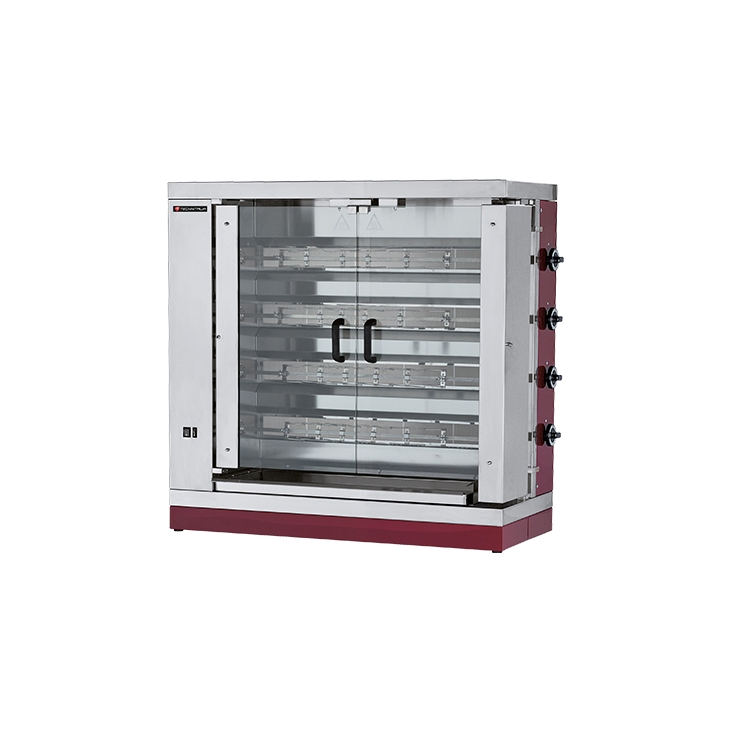
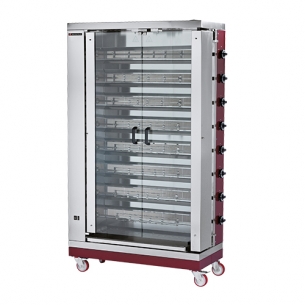
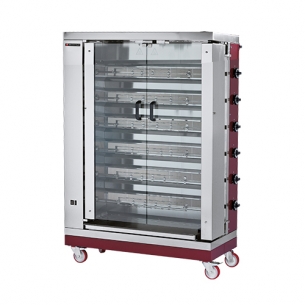
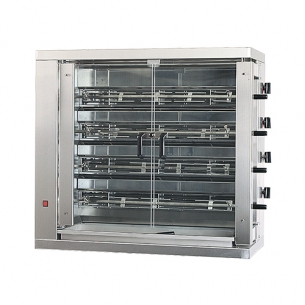
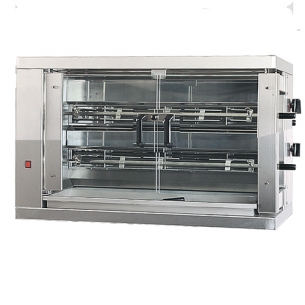
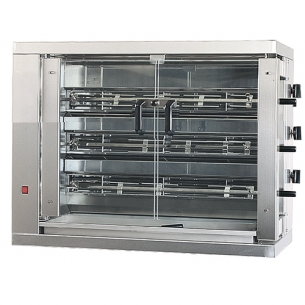
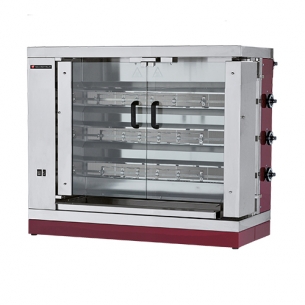
The gas spit rotisserie with 4 spits roasts 16 chickens at once at 24kW, on propane/butane bottle or natural gas. At €3,900 excl. VAT in the compact 1100×480mm gas width, it brings high roast capacity to markets and high-volume roast counters that need 16 chickens per load with no three-phase installation.
4 Spits, 16 Chickens: High Gas Capacity
- 16 chickens at once on 4 spits — high capacity for a busy stall or counter
- 24kW gas — strong even heat to roast a full load to a golden finish
- Propane/butane or natural gas — bottle-ready, no three-phase, mobile
- Compact 1100mm width — high capacity without a wider footprint
Who Is the 4-Spit Gas Rotisserie For?
- Busy market rotisseries — 16 chickens per load to keep up with peak demand
- High-volume roast counters and caterers — strong gas capacity, no three-phase
- Operators wanting maximum gas capacity — short of the 8-spit, in a compact width
Technical Specifications
| Parameter | Value |
|---|
| Type | Gas spit rotisserie |
| Capacity | 4 spits — 16 chickens at once |
| Power | 24 kW |
| Fuel | Gas (propane/butane or natural) |
| Footprint | 1100 × 480 mm |
| Price excl. VAT | €3,900 |
Why a Spit Rotisserie Sells Roast Chicken
A spit rotisserie is both a cooking tool and a sales tool. As the chickens turn slowly on the spits behind glass, they self-baste in their own dripping juices — the rotation continuously coats the skin, giving the even golden colour and crisp, glossy finish that defines a great rotisserie chicken, with flesh that stays moist to the bone. And the sight of rows of golden chickens turning in the window is one of the most effective impulse-sale displays in food retail: the rotisserie sells the product before a word is spoken.
Capacity: Match the Spits to Your Volume
Capacity is set by the number of spits and the chickens per spit. Size the rotisserie to your peak daily roast volume: too small and you sell out before the rush ends; too large and you roast chickens you will not sell. A market rotisserie, a butcher, a deli, a supermarket roast counter and a traiteur each have a different volume — the range steps up spit by spit so you can match the machine to the throughput you actually need.
Gas or Electric: Which to Choose
Gas rotisseries run on natural gas or a propane/butane bottle, which makes them ideal for market stalls, mobile operations and sites without a three-phase supply — and many operators value the traditional flame roast. Electric rotisseries need a three-phase 400V supply but offer precise, clean, flame-free heat with no gas connection. Choose gas for mobility and no three-phase; choose electric for a fixed site already wired for 400V.
Stainless Steel, Cleaning and HACCP
The rotisserie is built in food-grade stainless steel with a tempered-glass front. A drip tray catches the juices and fat for easy removal; the spits, trays and glass clean down between services and slot into your HACCP plan. Holding and roasting at controlled temperature keeps the product within the safe ranges your HACCP plan requires.
MFF Guarantee & After-Sales: 1-year manufacturer guarantee, extended guarantee available. MFF technical support and spare parts. Delivery 48–72h mainland France.