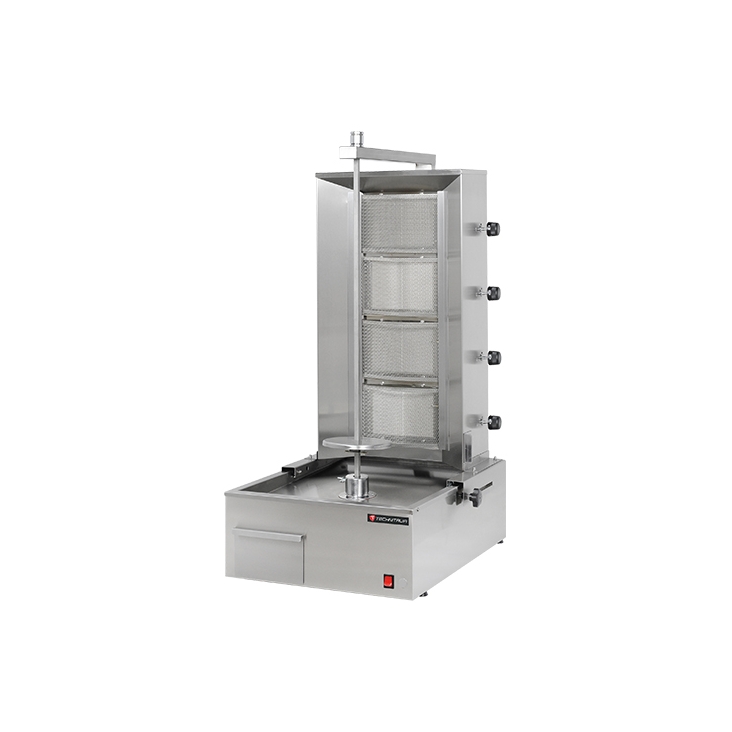
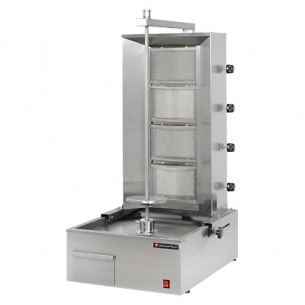
The NDG60 gas döner grill is the reference equipment for kebab restaurants, snacks with spit service and establishments offering gyros or shawarma. 60 kg of meat a day in vertical gas cooking, 10.5 kW of heat output, 540 × 670 × 990 mm format. Gas brings the direct heat that gives spit meat its character: the caramelised surface, the grilled aromas, the texture of döner sliced to order in front of the customer.
For which establishment?
The NDG60 is sized for moderate volumes — between 60 and 100 kebab covers per service for an establishment offering kebab as its main product. In practice:
- Neighbourhood kebab restaurants: one lunch and one dinner service with 50 to 70 covers per service. The spit turns continuously, the meat is sliced on demand, 60 kg/day is the standard capacity for this volume.
- Sandwich shops with a kebab spit: kebab is one product among others — sandwiches, tacos, wraps. The spit is used continuously during opening hours but not at full pace. 60 kg/day is amply sufficient.
- Greek restaurants and gyros establishments: same use, same meat (lamb, chicken, blend), same vertical-cooking technology. The term "döner grill" refers to the machine whatever the culinary tradition — Turkish kebab, Greek gyros, Lebanese shawarma, Mexican al pastor.
- Caterers and events: a spit set up for an event, intensive use over a half-day or full day — 60 kg covers a standard catering job.
If volume regularly exceeds 60 kg/day or service is continuous over 12 hours with queues, the NDG80 (80 kg/day, 14 kW) is more suitable. The NDG60 is the right balance of capacity and cost for standard-volume establishments.
Gas vs electric for a döner grill: how to choose?
The choice between gas and electric for a döner grill depends on the premises' installation and the priority given to flavour:
- Gas (NDG60, NDG80): high heat output (10.5-14 kW), direct flame heat, fast heat-up, the flavour characteristic of flame cooking. Requires a gas supply (natural or propane), compliant ventilation and connection by a certified professional. Gas cost is generally lower than electricity for the same calories produced.
- Electric (NDE60, NDE80): lower power (2.8-4.2 kW), no gas, direct installation on an electric socket (single-phase 230V or three-phase 400V), simpler to install in premises with no gas supply. The cooking result is excellent but slightly different from a direct flame.
In professional kebab catering, gas remains the reference for flavour and power. Electric suits premises with no gas or under strict ventilation restrictions.
Technical specifications
| Parameter | Value |
|---|
| Reference | NDG60 |
| Supply | Gas (natural or propane) |
| Power | 10.5 kW |
| Capacity | 60 kg/day |
| Dimensions (W × D × H) | 540 × 670 × 990 mm |
| Casing | Stainless steel |
| Price excl. VAT | €1,440 |
NDG60 vs NDG80 vs NDE60: which döner grill to choose?
| Criterion | NDG60 (this model) | NDG80 | NDE60 |
|---|
| Energy | Gas | Gas | Electric 230V |
| Power | 10.5 kW | 14 kW | 2.8 kW |
| Capacity/day | 60 kg | 80 kg | 40 kg |
| Format (H) | 990 mm | 1100 mm | 900 mm |
| Price excl. VAT | €1,440 | €1,560 | €1,620 |
The NDG60 is the gas entry point — the right choice if 60 kg/day capacity is enough and the premises have a gas supply. At €120 less than the NDG80 for 20 kg/day less capacity, the capacity/price ratio is excellent for small and medium volumes.
What restaurateurs ask
- What is the difference between a döner grill and a classic kebab spit?
- "Döner grill" and "kebab spit" refer to the same type of equipment under different names depending on the supplier. The technology is identical: a column of pressed meat is fixed on a vertical axis and turns slowly in front of heating elements (gas burners or electric elements). The meat cooks on the surface, the operator regularly slices the cooked outer layers. The term "döner" comes from "döner kebab" (Turkish for "turning meat"). The vertical spit suits Turkish kebab, Greek gyros, Lebanese shawarma and all vertical-rotation meat cuisines.
- Can a gas döner grill be used indoors?
- Yes, provided the premises' ventilation complies with professional standards for gas appliances. A gas döner grill produces combustion gases that must be extracted via a compliant hood or ventilation system. A professional gas connection is mandatory (Qualigaz-certified or equivalent). In premises with no possible gas connection or no suitable hood, the electric döner grill is the compliant solution with no combustion ventilation constraint.
- Is the meat spit included with the grill?
- The vertical spit (axis + fixing cones) is generally included with the döner grill. Check the precise list of accessories supplied — some models need separate purchase of extra spits or grease collection trays. The grease collection tray is a critical accessory for daily cleaning and HACCP compliance; make sure it is included in the delivery.
- How long does it take to set up a meat column and heat it?
- Heating a gas döner grill (to optimal cooking temperature) takes 10 to 15 minutes. Setting up a 20 to 30 kg meat column takes 5 to 10 minutes depending on operator experience. In practice, the grill is lit 15 to 20 minutes before service starts, the column is set up during this preheating, and the first meat is ready to slice at the start of service. At close, a full clean (grease tray, burners, surfaces) takes 15 to 20 minutes.
To compare with the NDG80 (80 kg/day) or the electric NDE60/NDE80 döner grills, our team is available via the contact form.
MFF Guarantee & After-Sales: 1-year manufacturer guarantee, extended guarantee available. MFF technical support and spare parts. Delivery 48–72h mainland France.