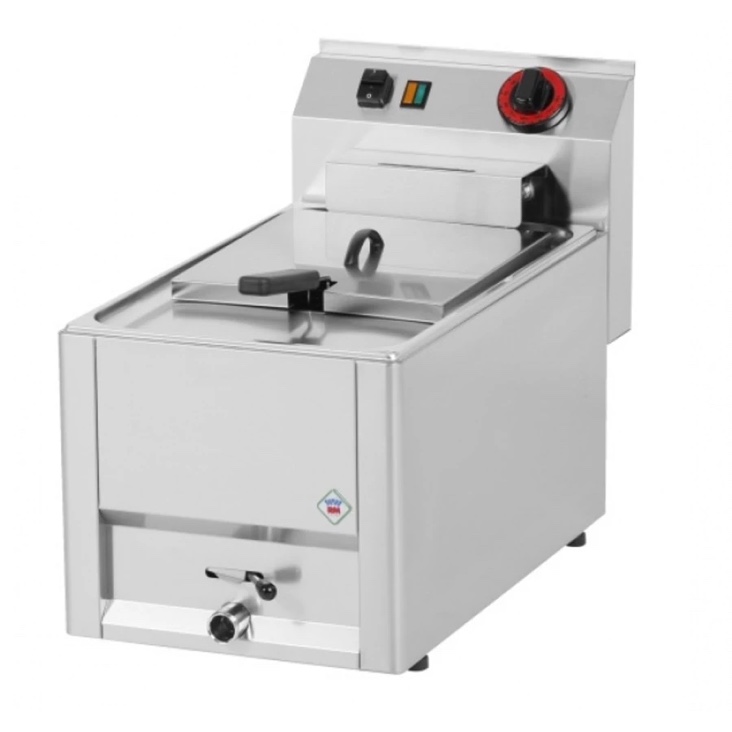
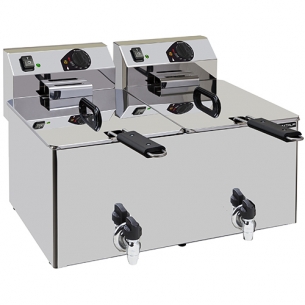
Looking for a countertop fryer that holds a real service rather than covering the occasional rush? This professional 8-litre countertop fryer is rated at 6 kW on 400 V three-phase. That figure is the whole point: most 8-litre fryers on the European market top out between 3.2 and 3.6 kW because they are designed to run off an ordinary single-phase socket. This model is sized for the power an 8-litre bath actually needs in continuous service.
6 kW on 8 litres: what power really changes
Fryer power is not about cooking hotter — the thermostat caps at 190 °C either way. It is about temperature recovery. Every time a basket of frozen chips goes in, the oil temperature drops sharply. What decides the quality of the result is how fast it climbs back to the set point.
- On an underpowered fryer, recovery drags. Chips sit too long in lukewarm oil, soak up fat and come out limp. It is the classic failure of entry-level machines as soon as the rush starts.
- With 6 kW on 8 litres, recovery is fast: baskets follow one another without the temperature collapsing, and the last batch of service matches the first.
- The heating element is a large-surface coil immersed directly in the bath. Heat spreads through the whole tank instead of concentrating on a hot spot, so the oil ages more slowly and the element lasts longer.
Check before ordering: this model runs on 400 V three-phase with neutral (3N ~ 50 Hz). A domestic single-phase socket will not do. Check your consumer unit first — if your premises are not wired for three-phase, budget for an electrician.
600 mm depth: a format built to line up
This fryer is built around a standard 600 mm depth, the reference format for professional cooking lines. In practice: add a griddle, a grill or a boiling top in the same format later and everything lines up to the millimetre on the worktop. Nothing sticks out, the run stays clean and the surface wipes down in a single pass.
At 330 mm wide, it takes up only a narrow strip. The worktop is 0.80 mm AISI 304 stainless steel — the reference food-grade stainless in professional kitchens: it takes acidity, detergents and daily cleaning without pitting or dulling.
The front drain tap: the detail that decides maintenance
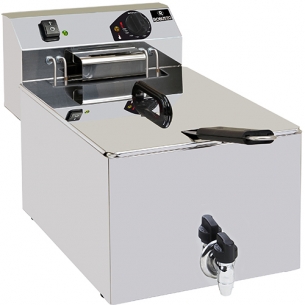
Emptying 8 litres of used oil is the most awkward and the most dangerous job in fryer maintenance. Without a tap you have to lift a full tank and pour it out: hazardous when hot, messy when cold. On this model the drain tap sits on the front panel, reachable without moving the machine: slide a container underneath and open it.
The effect on the business is immediate. When draining is easy, oil gets changed on schedule instead of being pushed through "one more service". That is taste on the plate, and an oil budget that stops drifting.
The fryer ships with its lid — essential for covering the bath off-service and slowing oxidation — and its basket, 210 × 235 × 100 mm.
Which businesses is it for?
- Snack bars, sandwich shops, chip shops: chips are a draw product and must be consistent from the first customer to the last. An 8-litre tank at 6 kW holds a continuous service on a menu where frying matters without being the only focus.
- Brasseries and traditional restaurants: a dedicated frying station, kept away from the range, for sides and fried starters. The countertop format avoids committing floor space to a cabinet unit.
- Food trucks and events with three-phase supply: 330 mm wide, a machine that wedges in, travels and restarts quickly.
- A second frying station in an already equipped kitchen: double peak-hour capacity without touching the cooking line layout.
Technical specifications
| Specification | Value |
|---|
| Tank capacity | 8 litres |
| Electrical power | 6 kW |
| Supply | 400 V / 3N ~ 50 Hz (three-phase + neutral) |
| Thermostat range | 50 to 190 °C |
| Safety thermostat | 235 °C |
| Dimensions (W × D × H) | 330 × 600 × 290 mm |
| Basket | 1 basket — 210 × 235 × 100 mm |
| Worktop | AISI 304 stainless steel, 0.80 mm |
| Heating element | AISI 304, large-surface coil, immersed in the tank |
| Drain | Front-panel tap |
| Control protection | IPX4 |
| Installation type | Countertop |
| Supplied with | Lid, basket, drain tap |
One tank or two? How to choose
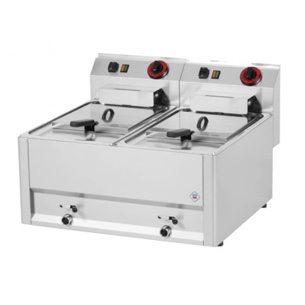
| Criterion | 1 × 8 L tank (this model) | 2 × 8 L tanks |
|---|
| Tanks | 1 × 8 L | 2 × 8 L, independent |
| Power | 6 kW | 12 kW |
| Width | 330 mm | 658 mm |
| Separate oils | No — a single bath | Yes — 2 separate baths |
| Best for | Menus where frying is a side | Mixed menus: chips + fish, doughnuts, nuggets |
| Price excl. VAT | €890 | €1,690 |
The rule is simple: if everything you fry can share the same oil, one tank is enough and this model is the right call. As soon as your menu mixes strongly flavoured products — breaded fish, sweet doughnuts, onions — you need two separate baths, and the twin-tank model is the one to look at.
What operators ask
- Why does an 8-litre fryer need three-phase?
- Because a single-phase 230 V / 16 A socket delivers roughly 3.7 kW at most. To go beyond that ceiling and reach the 6 kW that makes fast temperature recovery possible, you have to move to 400 V three-phase. That is precisely what separates a professional fryer from a reinforced consumer model.
- Can it run off a normal socket?
- No. This model requires a 400 V three-phase supply with neutral (3N ~ 50 Hz) and a connection made by a qualified electrician. If your premises have single-phase only, look at a lower-powered single-phase fryer — our team can point you to suitable models.
- Are the lid and basket included?
- Yes, both are supplied as standard, along with the drain tap. The lid is not a comfort accessory: covering the bath off-service limits contact between oil and air and slows oxidation considerably.
- Why does the 600 mm depth matter?
- Because 600 mm is the standard depth for professional cooking lines. Fryers, griddles, grills and boiling tops built on that base line up perfectly side by side, so you can build a coherent cooking run over time without rethinking the layout.
- How do you clean the tank day to day?
- Drain the oil through the front tap once the tank is lukewarm, remove the debris from the bottom, then degrease the tank and worktop with hot water and a food-safe detergent. AISI 304 stainless steel takes that daily routine without dulling. Cover the bath at the end of service: it is the single most effective step against oil oxidation.
Delivery and commissioning
Professional delivery across mainland France and Europe. The 400 V three-phase connection must be carried out by a qualified electrician: confirm three-phase availability on site before ordering. Our sales team is available for a quotation, a technical question, or to check the compatibility of your installation with you.