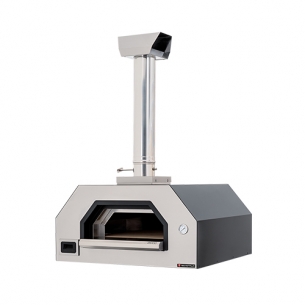
The WOOD wood-fired pizza oven is the equipment for pizzerias and Italian restaurants that want to offer an authentically Neapolitan pizza experience: wood-fire cooking, at 400-500°C, on a refractory stone sole. The flavour wood gives the crust — slightly smoky, complex, with that note of rapid caramelisation — is impossible to reproduce in an electric or gas oven, whatever its technology. The WOOD is the oven for those who make authenticity their main argument.
The forno a legna: why wood changes everything
Wood-fire cooking in a professional pizza oven is not a matter of nostalgia — it is a fundamentally different cooking technique from electric or gas ovens. A lively wood fire generates a unique combination of three types of heat at once: the radiant heat of the red-hot dome (which cooks the toppings from above), the conductive heat of the stone sole (which cooks the dough from below), and the convective heat of the flames (which circulates in the chamber and cooks the sides of the crust). This combination, with temperatures of 450 to 500°C, cooks a Neapolitan pizza in 60 to 90 seconds — with a puffed, leopard-spotted cornicione (rim), a crisp sole and a base slightly charred at the contact points ("leoparding"), impossible to achieve otherwise.
The WOOD's refractory stone sole accumulates the fire's heat during the preheat phase (generally 1h30 to 2h to reach service temperature) and returns it perfectly evenly throughout the service. Unlike electric ovens which regulate temperature electronically, managing heat in a wood-fired oven is an art — a strong differentiating factor for pizzerias that want to stand out through technical mastery.
For which establishment
The WOOD is the oven for pizzerias that claim Neapolitan authenticity as a central element of their positioning: "Neapolitan pizzeria", "forno a legna", "wood-fired pizza". It is also the oven for gourmet Italian restaurants whose chef is trained in the Neapolitan tradition and wants a tool worthy of their know-how. Finally, it is the choice for establishments that have the technical configuration to install it: flue, sufficient space, and staff trained in wood-fire management.
The forno a legna requires more investment in skills than an electric oven: you need a pizzaiolo able to manage the fire zone, to move the pizza manually with a peel, to watch the cooking to the second and to hold the temperature by adding wood during service. This know-how is itself a strong commercial argument — the forno a legna visible from the dining room is a show in itself that creates a unique customer experience.
Technical specifications
| Reference | WOOD |
|---|
| Oven type | Professional wood-fired pizza oven |
|---|
| Fuel | Wood (no electrical or gas connection required for cooking) |
|---|
| Sole | Refractory stone |
|---|
| Dimensions (W × D × H) | 1,100 × 1,080 × 1,680 mm |
|---|
| Weight | 200 kg |
|---|
| Service temperature | 400 to 500°C (managed by the pizzaiolo) |
|---|
| Price excl. VAT | €4,320 |
|---|
Wood-fired vs electric oven: comparison
| Criterion | WOOD wood-fired oven | XL/MASTER electric ovens |
|---|
| Flavour | Wood smoke + unique caramelisation | Neutral (no combustion flavour) |
| Temperature | 400-500°C (lively wood) | Up to 500°C (thermostat) |
| Regulation | Manual (fire management) | Automatic (thermostat) |
| Preheat time | 1h30-2h00 | 30-60 min |
| Skill required | Forno a legna-trained pizzaiolo | Standard staff |
| Installation | Flue mandatory | Three-phase or single-phase connection |
| Experience value | Very high (visible from dining room) | Standard |
| Price excl. VAT | €4,320 | €1,990 – €8,400 |
What restaurateurs ask
- Does a wood-fired pizza oven need special authorisations?
- Yes. In France, installing a wood-combustion appliance in premises open to the public (ERP) is subject to strict regulations: a standards-compliant flue (DTU 24.1 for flues), prior declaration or building permit depending on the works, and a professional chimney sweep inspection at least once a year. Consult your town hall and check with a certified professional before any installation. Co-ownerships and some urban zones may prohibit wood installations.
- What type of wood for a professional pizza oven?
- Dry hardwood is recommended: oak, beech, ash, hornbeam — dense woods that burn long at high temperature and produce little greasy smoke. Avoid resinous woods (pine, fir) which produce creosote residue in the flue and undesirable flavours. The wood must be well dried (moisture under 20%) for efficient combustion and fast heat-up. Plan a dry storage space for the wood near the oven.
- How many pizzas can the WOOD cook in an hour of service?
- At 450-500°C with an experienced pizzaiolo, count 3 to 4 pizzas at once and a rotation every 60 to 90 seconds — i.e. 40 to 60 pizzas an hour at cruising pace. This throughput is lower than electric ovens of equivalent capacity, but the value of wood-fired pizza often compensates with a higher selling price and a higher customer satisfaction rate.
- Can the WOOD be installed on a terrace or outdoors?
- The WOOD oven is designed for indoor installation with a flue. Installation on a covered terrace is possible if fire-safety standards are met (distance to flammable materials, sufficient ventilation, suitable flue). Open-air or temporary-tent installation requires a specific risk analysis with the safety services. Contact our team for any non-standard installation.
Delivery and commissioning — The WOOD oven weighs 200 kg and needs a coordinated delivery with suitable access. Delivery and installation on request — contact us before ordering to validate access conditions and the installation quote. Forno a legna cooking training included on request, via the contact form.
MFF Guarantee & After-Sales: 1-year manufacturer guarantee, extended guarantee available. MFF technical support and spare parts. Delivery 48–72h mainland France.