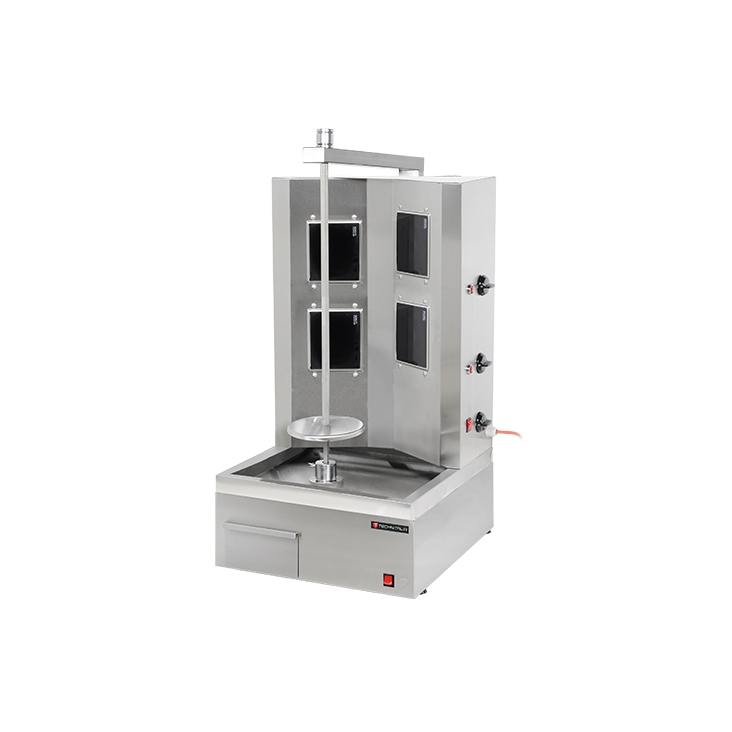
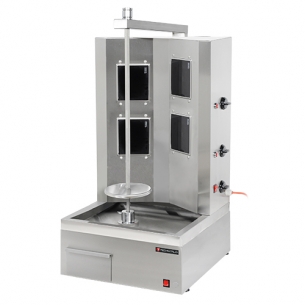
The NDE60 electric döner grill answers a common constraint in fast catering: wanting to offer kebab without a gas supply in the premises. 2.8 kW on single-phase 230V, 40 kg of meat a day, compact 500 × 500 × 900 mm format — the equipment for all establishments wanting a professional vertical spit without the constraints of a gas connection.
Why choose electric over gas?
The choice between gas and electric for a döner grill is rarely a matter of preference — it is almost always an installation constraint:
- Premises with no gas supply: shopping arcades, basements, upper floors — many modern commercial premises have no natural gas. Bottled propane is an alternative but imposes storage and extra safety constraints. Electric plugged into 230V is the immediate solution.
- Ventilation restrictions: gas appliances need compliant combustion-gas extraction. In some premises (basement, insufficient ventilation, listed building), gas installation can be impossible or too costly. Electric emits no combustion gas.
- Food trucks and kiosks: gas supply is hard to manage on the move. A 230V generator is enough to power the NDE60.
- Ghost restaurants and shared kitchens: multi-tenant premises where gas access is limited or subject to landlord restrictions.
In terms of cooking result, the electric spit gives a result very close to the gas spit — the meat cooks the same way (radial heat, slow rotation, surface slicing). The nuance is the absence of direct-flame aromas, noticeable to very trained palates but imperceptible to the standard clientele.
For which establishment?
The NDE60 is calibrated for moderate volumes with no gas constraint:
- Kebabs in a shopping arcade: no gas, standard hood, moderate customer flow — 40 kg/day covers a service of 150 to 200 kebabs a day.
- Snacks and sandwich shops with a spit: kebab is one product among others, the spit turns continuously but not at full load — 40 kg/day is amply sufficient.
- Greek and shawarma restaurants in restricted space: the compact 500 × 500 mm format fits into small-area kitchens without sacrificing spit service.
- Test restaurant opening: before investing in a gas installation, the NDE60 lets you start immediately, validate volume and adjust the future model.
Technical specifications
| Parameter | Value |
|---|
| Reference | NDE60 |
| Supply | Electric — single-phase 230V |
| Power | 2.8 kW |
| Capacity | 40 kg/day |
| Dimensions (W × D × H) | 500 × 500 × 900 mm |
| Casing | Stainless steel |
| Price excl. VAT | €1,620 |
NDE60 vs NDG60 vs NDE80: which döner grill for my use?
| Criterion | NDE60 (this model) | NDG60 | NDE80 |
|---|
| Energy | Electric 230V ✓ | Gas | Electric TRI 400V ⚠️ |
| Power | 2.8 kW | 10.5 kW | 4.2 kW |
| Capacity/day | 40 kg | 60 kg | 80 kg |
| Installation | Direct 230V socket | Gas connection | Three-phase 400V required |
| Price excl. VAT | €1,620 | €1,440 | €1,980 |
The NDE60 is the only electric döner grill installable on a standard single-phase 230V socket. If the premises have gas and good ventilation, the NDG60 at €1,440 is cheaper and more powerful. If volume exceeds 40 kg/day and three-phase is available, the NDE80 is the higher-capacity electric alternative.
What restaurateurs ask
- Is the cooking quality of an electric döner grill identical to a gas grill?
- The cooking result is very close in both cases. Radial heat (heating elements on the sides of the meat column) produces the same caramelised surface, the same texture and the same final result. The notable difference is the absence of direct-flame aromas — subtle, noticeable to connoisseurs, invisible to the standard clientele. In urban fast catering, almost all customers cannot tell the difference between gas- and electric-cooked meat if the quality of the meat itself is identical.
- Can a 2.8 kW döner grill cook fast enough for a lunch service?
- Yes, with a suitable preheat time. An electric döner grill of 2.8 kW switched on 20 to 25 minutes before service reaches its optimal temperature and maintains continuous cooking. The 2.8 kW power is lower than a gas model (10.5 kW) but the comparison is not direct: gas heats "in mass" by direct combustion, electric by radiant heating elements. For 40 kg of meat a day, 2.8 kW is correctly sized.
- Does the NDE60 run on a standard socket or is a reinforced socket needed?
- The NDE60 (2.8 kW, 230V) draws about 12-13 A in continuous use. A standard 16 A socket (type F, French or Schuko) is sufficient. Prefer a dedicated circuit for the appliance (no sharing with other powerful equipment on the same circuit) and ensure the electrical board has a free 16 A breaker. No reinforced socket or electrician intervention needed for wiring — an existing 230V socket is enough.
To compare with the NDE80 (80 kg/day, three-phase) or the gas NDG60/NDG80 models, our team is available via the contact form.
MFF Guarantee & After-Sales: 1-year manufacturer guarantee, extended guarantee available. MFF technical support and spare parts. Delivery 48–72h mainland France.